
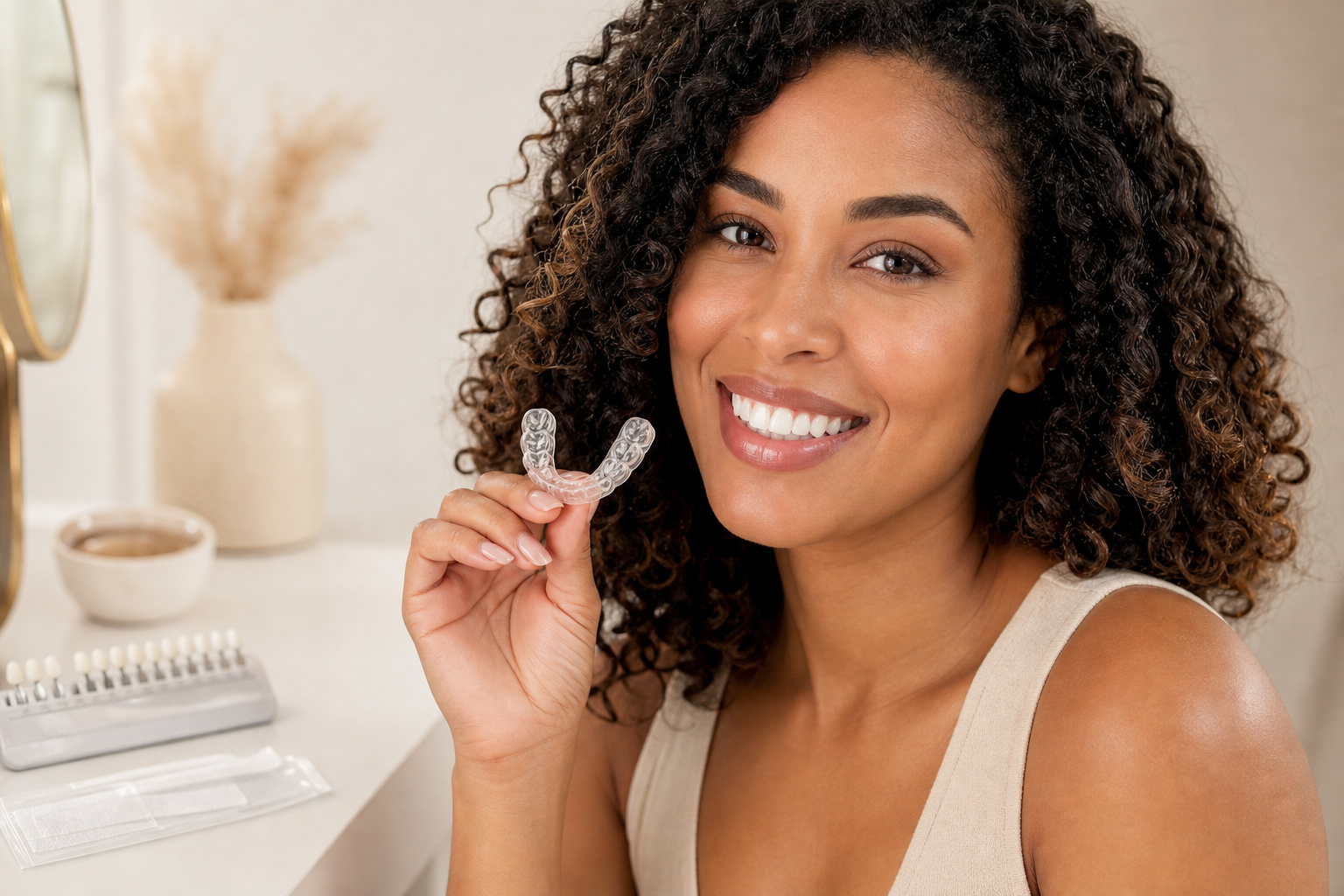
At-home teeth whitening and professional whitening are not true opposites. You can buy an over-the-counter product and use it independently, or you can use custom whitening trays at home under a dentist’s supervision. In-office treatment is the third option.
What changes between these routes is mainly the assessment, fit, application control, treatment pace, upfront cost, and access to follow-up. Professional care does not guarantee a whiter final shade or a sensitivity-free experience.
Quick answer: OTC whitening offers the lowest barrier to entry, dentist-supervised trays combine home use with customization, and in-office whitening provides clinician-controlled application. The best fit depends on your teeth, restorations, schedule, budget, and comfort with self-application.
The three whitening routes compared
The term “at home” can describe two meaningfully different options. Separating them makes the comparison much clearer.
| Factor | OTC at home | Dentist-supervised at home | In office |
|---|---|---|---|
| Initial assessment | No built-in dental examination | Dental evaluation before treatment | Dental evaluation before treatment |
| Application | You place generic strips, trays, or gel | You use custom-fitted trays and individualized directions | A dental professional applies the whitening agent |
| Gum protection and fit | Depends on product design and placement | Custom tray controls fit more precisely | Soft tissues can be protected during application |
| Routine | Repeated self-application according to the label | Repeated home use following the dentist’s plan | Active treatment happens during appointments |
| Upfront cost | Generally lower | Generally higher than OTC | Often the highest upfront commitment |
| Follow-up | Package directions and manufacturer support | Access to the dental practice | Access to the dental practice |
| Sensitivity risk | Possible | Possible | Possible |
The American Dental Association’s whitening overview recognizes all three routes. It also notes that OTC bleaching products generally use lower peroxide concentrations than professional approaches, but concentration alone does not determine the final result.
What professional whitening actually adds
The clearest benefit of professional care is not a guaranteed shade. It is the ability to evaluate your mouth and control the treatment more closely.
A dentist can look for decay, gum problems, cracks, existing restorations, and patterns of discoloration that may not respond predictably to bleaching. This matters because a widespread change in natural tooth color is different from one tooth becoming dark after an injury.
Dentist-supervised home whitening usually adds custom trays, a selected bleaching formula, individualized directions, and a contact point if problems develop. Custom trays are made for your mouth, unlike standardized OTC trays and strips.
In-office whitening places more of the application process in professional hands. According to the ADA’s consumer resource MouthHealthy, chairside treatment includes measures to protect the gums while the whitening agent is applied.
That control may be appealing if you do not want to manage repeated applications yourself. It still does not make whitening medically necessary or risk-free.
Does professional whitening produce better results?
Professional whitening should not automatically be translated as “better final result.”
An updated systematic review comparing dentist-supervised at-home bleaching with in-office bleaching found no significant difference in shade-guide color change or the risk of experiencing sensitivity. Some findings favored at-home treatment, but the authors rated the evidence as low quality.
An umbrella review of in-office and professionally supervised home techniques also found broadly similar color changes overall. The protocols and quality of the included research varied, so neither route earns a universal first-place ranking.
In-office treatment can concentrate active treatment into office visits, while custom trays distribute applications across a home routine. Faster active treatment does not necessarily mean a superior or longer-lasting final shade.
Marketing around lights or lasers can also make an office treatment sound dramatically different. Current review evidence does not establish a universal whitening advantage from light activation.
How OTC at-home teeth whitening differs
OTC whitening gives you more independence and usually a lower upfront cost. In exchange, you select the format, interpret the label, position the product, and monitor your response without built-in dental supervision.
That does not make every OTC product ineffective or inherently unsafe. A Cochrane review of home-use bleaching products found that chemical bleaching products could whiten teeth over the short term compared with placebo. However, the evidence was not strong enough to identify one superior composition, concentration, application method, or treatment duration.
When comparing OTC choices, check:
- Whether the product removes surface stains or contains a bleaching ingredient
- The intended contact time and frequency
- Warnings, age restrictions, and stop-use directions
- How the strip, tray, or applicator fits around your gums
- The plan for handling sensitivity or irritation
The ADA Seal of Acceptance can be another useful check when available. It is a voluntary evidence-review program, not government approval or a sign that the product equals dentist-supervised care. The absence of the Seal does not by itself prove that a product is unsafe.
Surface-stain removal is not the same as bleaching
Whitening toothpaste mainly helps remove external surface stains caused by things such as food and drinks. Peroxide bleaching products alter the apparent color of natural teeth.
This distinction matters when comparing cost and results. A stain-removing toothpaste should not be treated as a direct substitute for whitening strips, bleaching gel, custom trays, or an in-office procedure.
Whitening is cosmetic. Tooth color is not a reliable measure of cleanliness or oral health, and choosing not to bleach your teeth does not mean you are neglecting them.
Restorations and sensitivity can change the decision
Crowns, veneers, implants, fillings, and bonding do not whiten like natural teeth. If these are visible, bleaching the surrounding teeth could create or highlight a color mismatch.
Temporary tooth sensitivity and gum or oral irritation are possible with OTC, dentist-supervised, and in-office bleaching. Professional treatment cannot promise zero sensitivity, and discomfort is not proof that a product is working.
Speak with a licensed dentist before whitening if you have tooth pain, a single dark or changing tooth, suspected decay, gum problems, cracked teeth, damaged dental work, extensive visible restorations, persistent sensitivity, or discoloration of uncertain origin. A dentist is also the appropriate person for pregnancy-related questions about elective whitening.
Stop using a product and follow its label or seek professional advice if you experience burning, significant irritation, persistent sensitivity, or other concerning symptoms.
Choose based on the experience you want
Consider OTC whitening if you want a lower-cost, self-directed option, can follow a repeated routine, and have no obvious reason to seek an evaluation first.
Consider dentist-supervised trays if you want to whiten at home but prefer a custom fit, individualized instructions, and professional follow-up.
Consider in-office whitening if clinician application and fewer active-treatment visits matter more to you than minimizing upfront cost.
Whichever route you consider, follow one protocol exactly as directed. Do not extend the contact time, increase the frequency, sleep in a product unless instructed, or stack multiple whitening methods. Your most useful next step is to identify which of the three routes you are actually comparing, then evaluate its fit, supervision, routine, and sensitivity plan.
