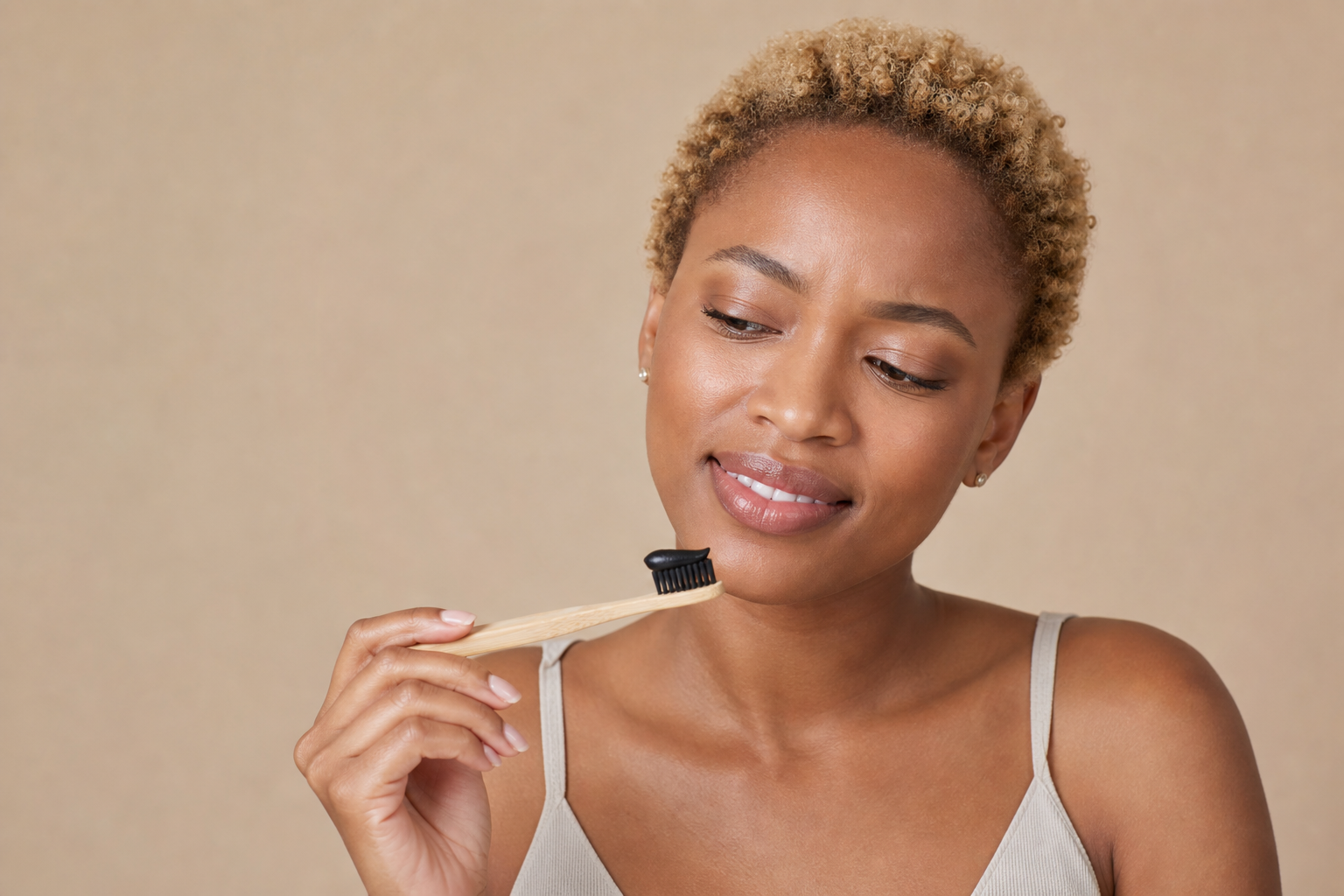
Charcoal toothpaste for white teeth has a striking look and a big online following, so it's fair to wonder whether it belongs in your routine. The short answer is no, not as a whitening plan. The American Dental Association says charcoal whitening has insufficient evidence of adequate safety and effectiveness. That's a weak foundation for something you'd use twice a day.
If a tube is already on your sink, you didn't make a bad call. It just shouldn't be the thing you count on for a brighter-looking smile.
Quick answer: The ADA says the evidence for charcoal whitening is not adequate on safety or effectiveness. Whitening toothpastes mainly tackle surface stains, although some formulas also contain peroxide. Changing the underlying color of natural teeth is what peroxide bleaching does. For everyday staining, stick with a regular toothpaste routine. For a real shade change, look at established whitening formats, ideally after a dental check.
What charcoal toothpaste for white teeth can and cannot do
"Whiter teeth" can mean two different things, and that difference shapes the whole decision.
- Surface stains sit on the outside of the tooth. Pigmented drinks, tobacco and time can all change how teeth look, according to MouthHealthy.
- Underlying tooth color is the shade of the tooth itself. The ADA explains that peroxide bleaching is what changes the color of natural teeth.
Most whitening toothpaste works mainly on surface stains. Some formulas contain peroxide, but charcoal itself is not an established bleaching agent. The black color of charcoal paste can make it look more powerful, but how a paste looks in the tube says nothing about what it does on your teeth.
It also helps to know what "white" realistically looks like. Brushing doesn't make natural teeth paper white, and teeth vary in shade from one to the next. A 2018 study of 640 young adults found canines tended to be darker and more yellow than incisors. A perfectly matching shade is not something to expect from a toothpaste.
What the evidence actually says
The clearest guidance comes from the ADA: charcoal whitening has insufficient evidence of adequate safety and effectiveness.
Read that precisely. "Insufficient evidence" is not the same as "proven harmful." It means the evidence isn't strong enough to show that charcoal reliably whitens teeth or that it's adequately safe for that purpose. Either way, it doesn't earn a spot as your whitening step.
A few things this article won't claim, because they need checking product by product:
- How gritty a specific charcoal paste is
- Whether a specific paste contains fluoride
- How a specific formula behaves around fillings, crowns or gums
Popularity isn't evidence either. As an editorial observation, glowing before-and-after clips can be shaped by lighting, filters and the contrast of dark foam against teeth. None of that tells you what's happening to tooth color.
Checks if you already use it
You don't need to panic-toss anything. You also don't need to treat it as a whitening plan. A few practical checks:
- Read the label. See what you're actually brushing with, including whether fluoride is listed.
- Don't push it harder. Brushing harder, longer or more often to "boost" results isn't a good idea with any paste.
- Skip the DIY versions. Don't add loose charcoal, powders, capsules or homemade mixtures to your routine.
- Ask about texture. If a paste feels gritty, ask your dentist whether it suits your teeth and any restorations.
- Stop if something feels wrong. If any product causes burning, significant irritation or other concerning symptoms, stop using it and get professional advice.
Restorations, sensitivity and when to see a dentist
Crowns, veneers, fillings and bonding don't lighten like natural teeth, according to both the ADA and MouthHealthy. That's true for charcoal paste and for proper bleaching, so any whitening attempt can leave restorations looking a different shade from the teeth around them.
MouthHealthy also notes that how teeth respond to bleaching depends on the type of discoloration. Color alone can't tell you the cause, so it's worth having a dentist look before you choose a method. The NHS describes a dentist checking teeth and gums before whitening. That's UK guidance, but the principle travels well.
Book a dental visit first if you have:
- Pain, cracked teeth, or untreated decay or gum problems
- Crowns, veneers, fillings or bonding on visible teeth
- Sensitivity that doesn't settle
- A tooth that has darkened or changed color without a clear reason
- Pregnancy-related questions
- Any doubt about whether whitening suits you
A dark or changing tooth isn't automatically a stain, so let a professional assess it rather than trying to brush it lighter.
Better routes to a brighter-looking smile
Start with your goal, then choose the route that actually matches it.
If you mostly notice everyday staining: Keep a regular toothpaste routine and mention the stains at your next dental visit. A dentist can tell you what you're looking at and what's worth doing.
If you want a real shade change: Look at established whitening formats. The ADA describes these options:
- Over-the-counter: strips, painted-on gels and trays
- Dentist-supplied: custom take-home trays
- In-office: whitening gel applied by a dental team, with or without a light
Over-the-counter options usually cost less. When comparing, look at what's included, such as a dental check, custom fit or follow-up, rather than price alone.
Whatever you choose, follow the label or your dentist's directions exactly. The ADA and NHS both note that whitening can cause sensitivity and gum irritation. These are possible side effects, not signs that a product is working. Results also vary by person and by the type of discoloration, so no method can promise a specific shade.
Whiter teeth are a cosmetic choice, not a score for health or cleanliness. Your smile doesn't need fixing. You're simply choosing how you'd like it to look.
Your next step
Decide what you actually want: fewer surface stains or a lighter overall shade. If it's the second, book a dental check and ask which whitening format fits your teeth, restorations and comfort level. Your charcoal paste can stay off the whitening plan.