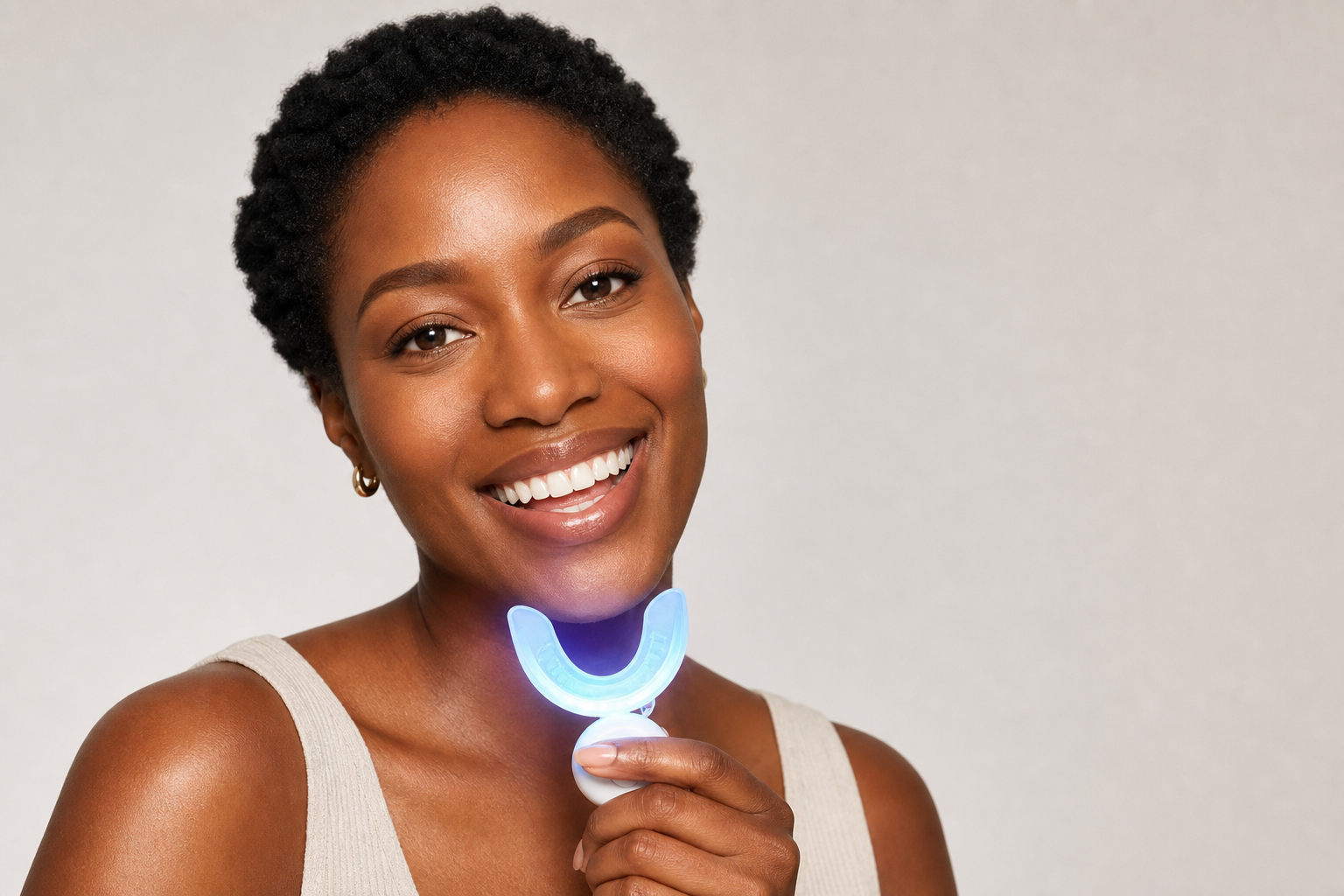
That glowing blue mouthpiece looks like the high-tech heart of the kit, but it usually isn't the part doing the whitening. LED teeth whitening kits can lighten natural teeth when they include an effective peroxide gel. The evidence that the light adds a meaningful extra boost is limited, and most of it comes from dental-office lamps rather than at-home devices.
The more useful question is whether this particular gel and system are worth it for your teeth and budget.
Quick answer: An LED kit may whiten your teeth because of its peroxide gel. Major reviews that compared the same professional gel used with and without light generally found no meaningful difference in results or sensitivity. Judge a kit by its formula, directions, fit, and evidence. Don't judge it by the glow.
What the Gel Actually Does
Most products that change the color of natural teeth rely on hydrogen peroxide or carbamide peroxide. The American Dental Association identifies these as the common bleaching agents. ADA's consumer site, MouthHealthy, explains that peroxide breaks down colored compounds inside the tooth.
That differs from whitening toothpaste, which mainly removes surface stains through polishing. Surface-stain removal clears away what sits on top of your teeth. Bleaching changes the shade of the natural tooth itself.
Either way, whitening is cosmetic. Tooth color is not a score for health, hygiene, or attractiveness.
What the Blue Light Is Supposed to Do
Product pages often say the LED "activates" or "accelerates" the gel. The theory is that light energy speeds up peroxide's breakdown, so more bleaching happens in less time.
There is narrow lab support for a version of this. One extracted-tooth study found that a specific 456 nm blue light paired with hydrogen peroxide increased the whitening rate under study conditions. It used only 30 extracted tooth samples. Its authors were also employed by Philips, and the study tested Philips bleaching products.
That result is interesting. It doesn't show that a generic mouthpiece speeds up any gel on living teeth.
What the Evidence Says About Light vs. No Light
The most useful test compares the same gel with and without light. A 2018 meta-analysis in the Journal of Dentistry pooled 21 randomized trials in adults. It found that adding light to in-office bleaching did not significantly improve color change or alter tooth sensitivity, whether the peroxide concentration was high or low.
A separate review in Operative Dentistry reached a similar conclusion. Its authors stated that a light source was not imperative for a good cosmetic result.
There is an important gap, though. Those studies looked at professional lamps, not small at-home mouthpieces. Consumer LED kits haven't been studied as a distinct category in any consistent way.
The home-whitening research that does exist is mixed in quality. A Cochrane review found that home bleaching products whitened teeth compared with placebo in short-term studies. However, the certainty of that evidence was low, and no application method was shown to be superior. A 2024 scoping review of over-the-counter products found the clinical evidence was strongest for strips. Tray-style products were supported mainly by laboratory research.
So a kit can produce a visible change even if its LED is unnecessary. Without a same-gel comparison, the result can't be credited to the light.
Blue vs. Violet: "LED" Isn't One Technology
Wavelength and formula matter. Researchers are exploring violet LEDs at around 405 to 410 nm. A systematic review of violet LED studies found a possible small effect but called the evidence non-definitive.
A 2026 review of light-assisted in-office bleaching described violet light with low-concentration peroxide as an emerging area that still needs more randomized trials. It specifically excluded at-home systems.
That research doesn't automatically apply to the blue light in most consumer kits.
Is the LED Worth Paying Extra For?
Not on its own. The light shouldn't earn a higher price just because it looks more technical. Before you buy, check these points:
- Active ingredient: Look for a clearly listed peroxide and, ideally, its concentration.
- Clear directions: The label should state gel amount, contact time, frequency, cleaning, and when to stop.
- Real evidence: Look for studies on the exact kit, or the same gel tested with and without its light, in living adults rather than only extracted teeth.
- Fit: Gel that spills onto your gums can cause irritation.
- Total cost: Include refill gels and the full number of sessions.
- Marketing terms: The FDA notes that registration or listing does not mean a device is approved, cleared, or certified. "UV-free" doesn't rule out sensitivity or gum irritation either.
Sensitivity, Restorations, and When to See a Dentist
The ADA lists temporary tooth sensitivity and gum irritation as common whitening side effects. The Cochrane review found they were more frequent with higher concentrations of the active ingredient. Concentration, contact time, frequency, and tray fit likely matter more for comfort than whether a light is attached.
Burning or tingling is not a sign that the kit is working harder. If you notice burning, significant gum irritation, or severe or lasting sensitivity, stop and follow the label. Seek professional advice if symptoms continue.
Follow the label exactly. Don't extend contact time, use the kit more often, or combine it with strips or other whitening products.
Only natural teeth whiten. Crowns, veneers, implants, fillings, and bonding stay the same shade, so they may stand out more afterward.
Talk with a licensed dentist before whitening if you have any of these:
- Dental pain
- Untreated decay or gum problems
- Cracked teeth
- Extensive restorations
- Ongoing sensitivity
- Pregnancy-related questions
A single tooth that has darkened, especially after an injury, deserves a dental exam rather than a whitening kit.
Your Next Step
Treat the gel as the main event and the light as optional. Compare kits by active ingredient, clear directions, comfortable fit, and evidence for the complete system. If restorations, sensitivity, or any oral concern complicates the decision, ask a dentist first.