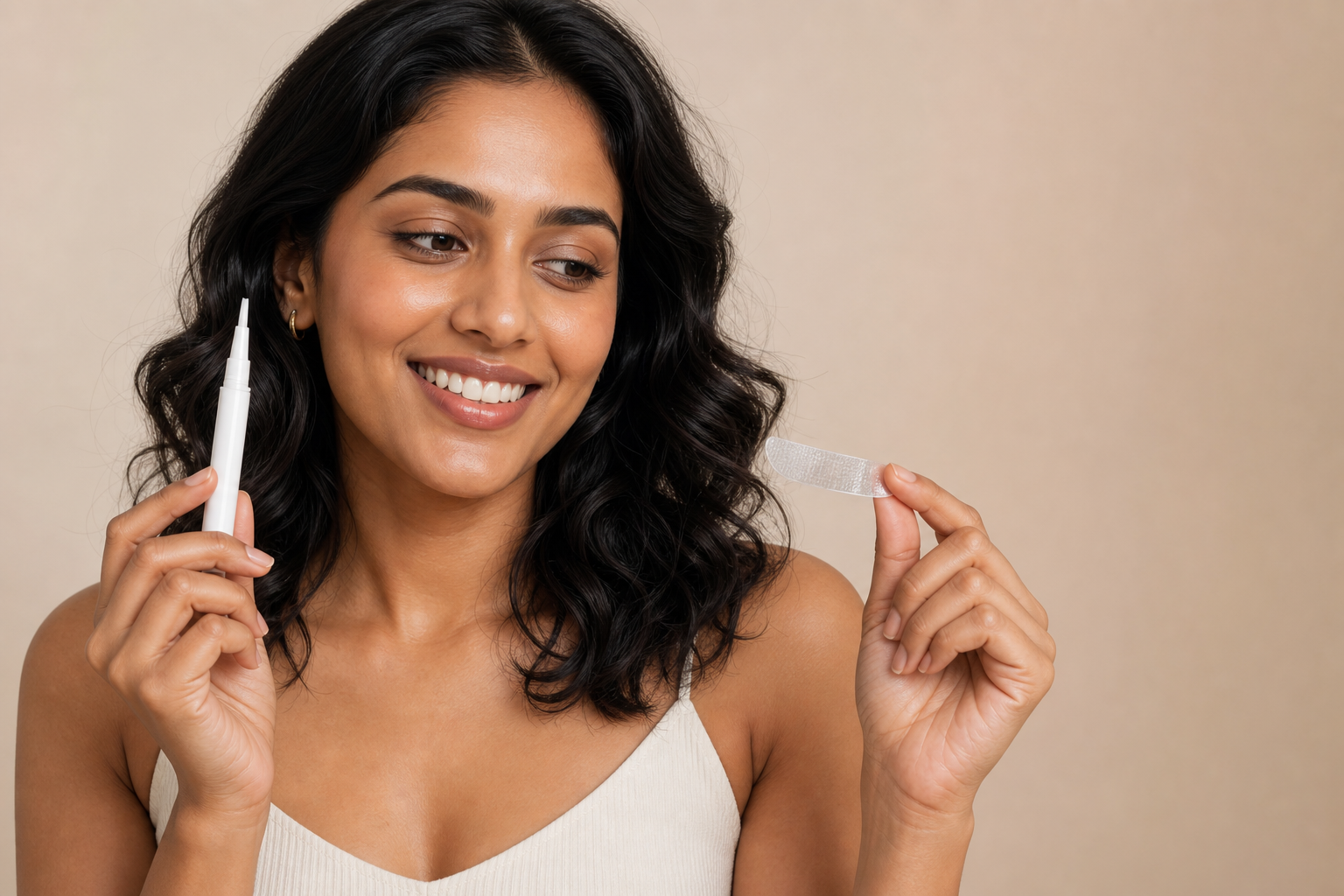
When you compare teeth whitening pens vs strips, you are mostly comparing how each one fits your routine. Neither is simply stronger or faster. Both are over-the-counter ways to get a whitening gel onto your teeth. Strips press on as a band. Pens let you paint gel onto teeth as their directions specify.
No reliable source crowns one format as the universal winner. The better pick is the one whose current label directions you can follow exactly, comfortably, and consistently.
Quick answer: Strips may suit you if you want a set, press-on routine that covers a band of teeth. A pen may suit you if you prefer a paint-on format. Either way, follow the label exactly. Only natural teeth will change color. Crowns, veneers, fillings, and bonding will not.
How Whitening Pens and Strips Differ
The American Dental Association lists strips and painted-on gels among over-the-counter whitening options. The ADA does not use the word "pen." A whitening pen is best understood as a paint-on gel format.
The real differences are practical. They come down to how the gel goes on, which teeth it reaches, and how it sits near your gums.
| Whitening strips | Whitening pens (paint-on gel) | |
|---|---|---|
| How it's applied | Pressed onto the front of your teeth | Brushed or painted onto individual teeth |
| Which teeth it reaches | A band of teeth along the strip | The teeth specified by the product directions |
| Gum-contact consideration | Fit and edge placement matter, because the ADA notes poor fit can contribute to gum irritation | Where the gel lands near your gums depends on your application and the product's directions |
| What to check on the label | Wear time, frequency, course length, brushing and eating rules | Contact time, frequency, course length, and any drying, eating, drinking, or talking rules |
| Who it may suit | Someone who likes a set, hands-off routine | Someone who prefers choosing which teeth to treat |
One caution about pens. Painting individual teeth sounds targeted, but that is an application difference, not a proven benefit. Do not assume a pen is gentler or more effective simply because you control its application.
Which One Fits Your Routine
This is where your habits matter more than marketing. Before choosing, read the current label of the specific product and ask yourself:
- Can you leave it undisturbed for the labeled time? If the label tells you to avoid eating, drinking, or talking during use, picture when that actually fits your day.
- Do you want structure or selection? Strips give you a defined routine. A pen lets you decide where gel goes, which some people find easier and others find fiddly.
- Does the label have brushing rules? These differ by product. For example, Crest says not to brush immediately before using its Whitestrips, to help avoid gum irritation, and allows gentle brushing right after. That applies to one product family, not every strip or pen.
- Is "on the go" really allowed? Pens are often marketed as portable. Whether quick touch-ups are appropriate depends entirely on your product's directions. More frequent use is not a shortcut.
- What's in the pack? Over-the-counter options usually cost less than professional whitening, according to the ADA. Still, compare how many applications each pack includes rather than the sticker price alone.
Whichever you choose, don't exceed the labeled frequency or contact time. Don't use a pen and strips at the same time. Stacking products can add irritation risk without a verified benefit.
Sensitivity, Gums, and Realistic Results
Both formats can cause temporary tooth sensitivity or gum irritation. The ADA and the NHS list these as possible side effects. Sensitivity is not a sign that a product is working.
If you notice burning, significant irritation, or sensitivity that lingers, stop. Follow the label's instructions and check in with a dentist.
Your expectations matter here too.
- Surface stains are different from tooth color. Removing surface stains is not the same as peroxide bleaching, which changes the color of natural teeth. The ADA explains the difference.
- Results depend on the discoloration. MouthHealthy notes that age, pigmented drinks, and tobacco can change how teeth look. How teeth respond to bleaching depends on the type of discoloration.
- Natural teeth vary in shade. In a study of 640 young adults, canines were generally darker and more yellow than front incisors. A slightly uneven look after whitening isn't automatically a failed product, and it isn't a reason to apply more.
- Restorations stay the same color. Crowns, veneers, fillings, and bonding do not lighten, so a visible mismatch is possible.
- White spots may stand out. Existing white spots can look more noticeable during whitening. A systematic review found only very low-certainty evidence on bleaching for white spots after braces.
Whitening is cosmetic. Your tooth color is not a score for health or cleanliness. No whitening product replaces brushing, cleaning between your teeth, or regular dental visits.
When to Check With a Dentist First
The NHS notes that a dentist checks teeth and gums before whitening, and MouthHealthy recommends discussing suitability with a dentist. Before choosing a pen or strips, consider booking a check if you have:
- Pain, untreated decay, or gum problems
- Cracked teeth
- Crowns, veneers, fillings, or bonding on visible teeth
- Persistent sensitivity
- Existing white spots
- A dark, changing, or uneven tooth whose cause you aren't sure about
- Pregnancy-related questions
This isn't a diagnosis list. These are situations where a professional view helps before you bleach anything.
A dentist may also mention a third path: custom take-home trays. The ADA notes that custom fit limits gum contact. The NHS describes dentist kits that include fitted trays, instructions, and a fit review. They usually cost more, but a pre-treatment check and individual fit are part of what you're paying for.
Your Next Step
Pick the format that matches how you actually live: press-on structure or paint-on selection. Then compare the current labels of two products in that format. Check contact time, frequency, eating and brushing rules, warnings, and the listed active ingredient. Choose the one you can follow exactly as written.