
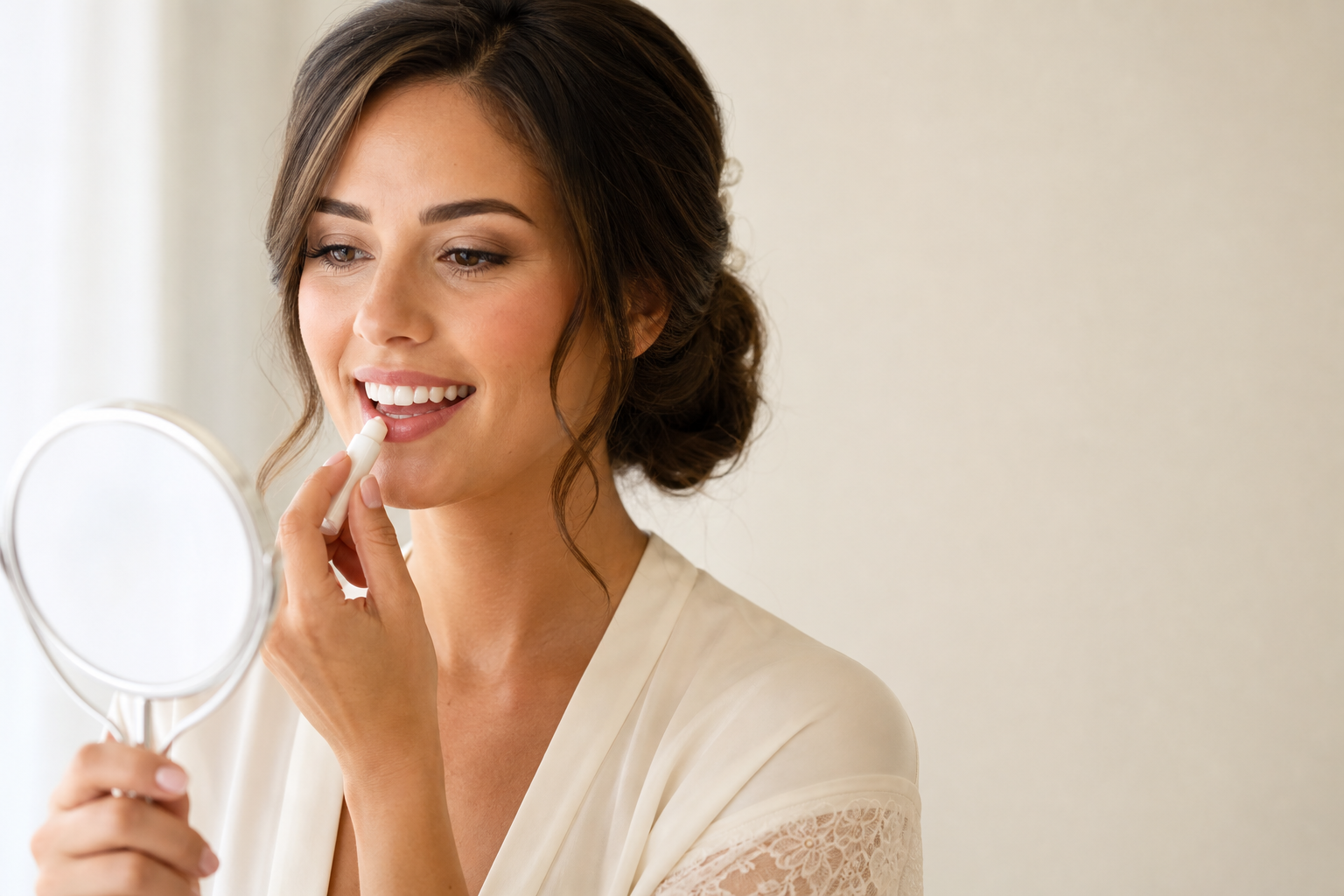
For wedding day white teeth, start planning eight or more weeks ahead if you can, then keep the final week deliberately uneventful. That window is a planning buffer, not a promise of a particular shade. It gives you time to identify restorations, choose one appropriate approach, monitor sensitivity, and test your makeup before the photos begin.
A sensible teeth whitening before wedding plan should fit into a broader wedding smile prep schedule and wedding beauty timeline. Treat it as one part of bridal beauty prep, alongside comfortable lip care and makeup testing, rather than the only route to a photo ready smile.
If the wedding is closer, resist the pressure to “catch up” with stronger or more frequent treatments. A familiar oral-care routine, comfortable lip care, and tested makeup are more predictable than a last-minute experiment.
Quick answer: Assess your teeth first, check for visible restorations, trial one whitening or stain-removal method as directed, stop if irritation becomes concerning, test your lip color on camera, and introduce nothing aggressive during the final week.
Why There Is No Universal Wedding Whitening Countdown
“Whitening” can describe two different cosmetic goals. Whitening toothpastes mainly remove external surface stains through cleaning, while peroxide bleaching changes the color of natural teeth. Neither method can guarantee a specific shade by a fixed date.
Your starting tooth color, type of discoloration, product directions, sensitivity history, oral health, and dental work all affect the decision. An evidence review comparing in-office and at-home bleaching found that both approaches can produce color change, but protocols and sensitivity outcomes vary. Faster is not automatically better for every mouth.
Whitening is optional and cosmetic. Natural tooth shades vary, and tooth color is not a reliable measure of cleanliness, health, attractiveness, or readiness for photographs.
Your Wedding Teeth Whitening Timeline
Use this timeline to decide what to assess and test, not as instructions to whiten continuously for eight weeks.
| Time remaining | Best focus | What to avoid |
|---|---|---|
| 8+ weeks | Check for restorations, unclear discoloration, sensitivity, and overdue dental care. Compare surface-stain removal, over-the-counter bleaching used as directed, dentist-supplied trays, and in-office care. | Buying a treatment before checking whether it suits your teeth. |
| 4–8 weeks | If whitening is appropriate, trial one method according to its label or your dentist’s plan. Track comfort as carefully as color. | Combining products, adding applications, or extending contact time. |
| 2–4 weeks | Reassess in consistent, unfiltered lighting. Start simple lip care and seek advice about persistent sensitivity or uneven color. | Trying to correct a mismatch around a restoration by bleaching more. |
| 1–2 weeks | Test lipstick and the complete makeup look in daylight, venue-like lighting, and phone flash. Check for lipstick transfer. | New aggressive whitening, lip peels, harsh scrubs, or irritating plumpers. |
| Final week | Continue only familiar, tolerated routines. Pack your tested lip product, balm, a mirror, and familiar floss or another interdental cleaner. | Emergency DIY whitening or an extra session outside the label or dental plan. |
Throughout the timeline, maintain normal oral hygiene. The American Dental Association recommends brushing twice daily for two minutes with fluoride toothpaste and cleaning between teeth daily. These habits support oral health, but brushing harder or more often will not guarantee a lighter shade.
Check Crowns, Veneers, Fillings, and Bonding First
Only natural teeth bleach. Crowns, veneers, implants, fillings, and bonding do not change color in the same way, according to the ADA’s whitening guidance.
That matters when dental work appears in your visible smile. Bleaching the surrounding natural teeth could make an existing restoration look darker by comparison, even if it looked well matched before.
Ask a licensed dentist about your options before whitening if you have visible restorations or plan to receive new bonding, crowns, veneers, or fillings. More bleaching is not necessarily the solution to uneven color.
Let Sensitivity Change the Plan
Temporary tooth sensitivity and gum irritation are possible whitening side effects. They are not proof that a treatment is working especially well.
Use only one approach, follow its directions, and do not:
- Double the application frequency
- Extend the stated contact time
- Sleep in a product unless explicitly directed
- Stack strips, gels, abrasive powders, and whitening toothpaste
- Use charcoal, acidic fruit, vinegar, household bleach, or improvised mixtures
Stop the product and follow its label or seek professional advice if you experience burning, significant gum or oral irritation, persistent sensitivity, or another concerning symptom. The ADA’s consumer whitening guidance also emphasizes consulting a dentist and avoiding product overuse.
Prepare Your Lips and Test Makeup on Camera
Lipstick can change how bright teeth appear by altering the surrounding contrast, but it does not whiten them. One limited study of lipstick and perceived tooth color found higher whiteness ratings with some red and purple lipstick images than with nude shades. That does not create a universal color rule.
Instead, compare colors you genuinely like under the lighting that will matter. Test daylight, indoor lighting, and phone flash, then check whether the formula transfers onto your teeth.
For comfortable lips:
- Use a familiar, non-irritating balm or ointment.
- Choose SPF 30 or higher lip protection outdoors.
- Avoid licking, biting, picking, or aggressively scrubbing dry skin.
- Stop using a product that burns, stings, or worsens cracking.
- Blot excess ointment before lipstick if it affects wear.
The American Academy of Dermatology recommends fragrance-free, non-irritating products for chapped lips. Persistent cracking, bleeding, sores, swelling, or signs of infection need appropriate clinical advice rather than another cosmetic treatment.
Know When Your First Step Should Be a Dentist
Contact a licensed dentist before whitening if you have tooth pain, untreated decay, gum problems, cracked teeth, substantial sensitivity, dental trauma, an isolated dark tooth, or discoloration you cannot explain. You should also ask for guidance if restorations affect the color match or you have pregnancy- or breastfeeding-related questions about elective whitening.
With a short runway, choose fewer variables rather than a stronger regimen. Check your calendar and visible dental work today, then decide whether your first wedding smile appointment belongs with a dentist instead of a retailer.
