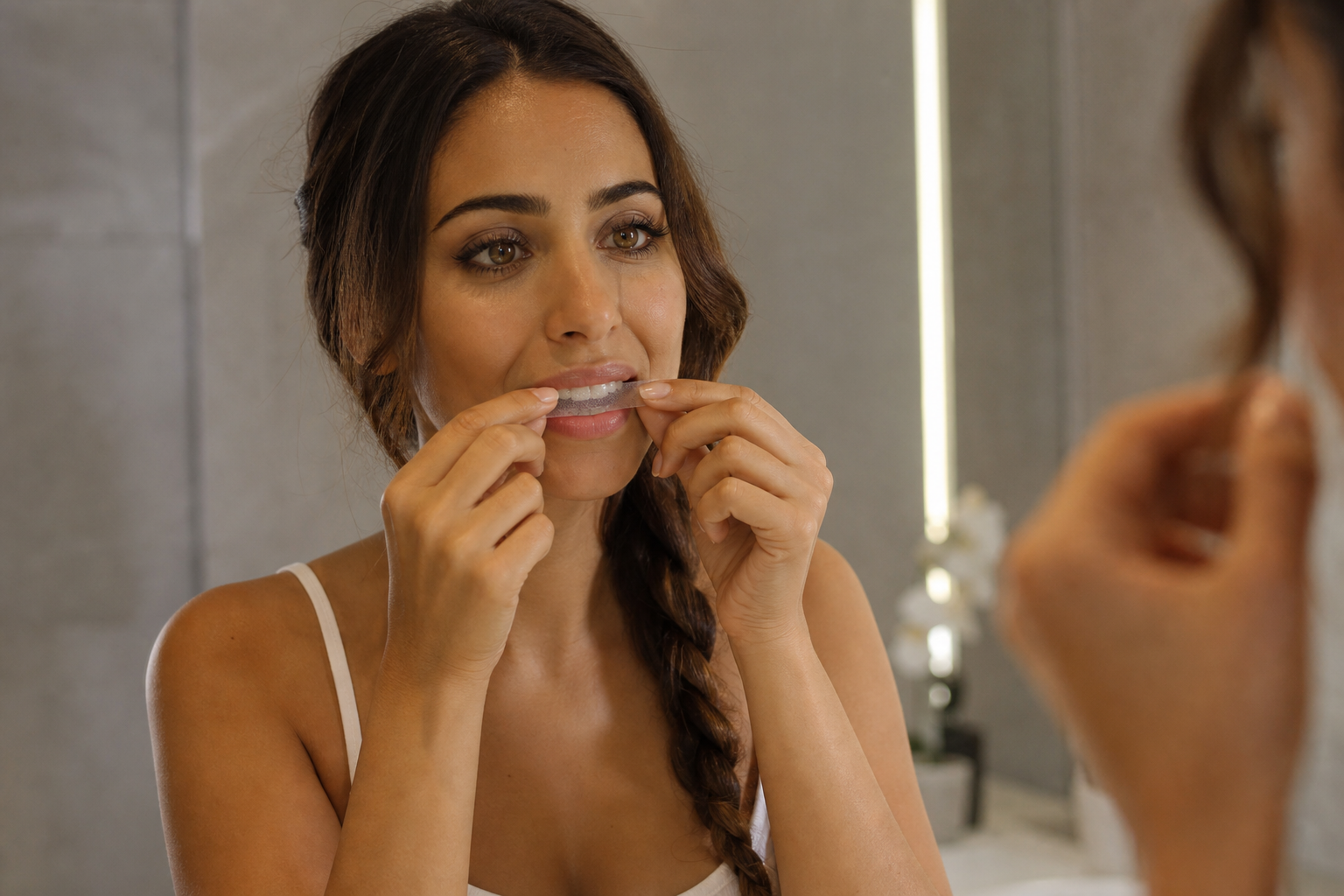
If your whitening strips keep slipping, treat it as a fit and placement signal instead of something to force. Before your next application, re-read your product's current directions, look at what you did right before applying, and notice whether your tooth shape, alignment, or dental work keeps a flat strip from sitting evenly.
You are probably not doing anything dramatically wrong. Strips are a one-shape format meeting a lot of different mouths, and sometimes the honest answer is that they are not the best match for yours.
Quick answer: Follow your current label's placement and prep steps exactly, place the strip once and leave it, and watch where it ends up. Skip adhesives, cutting, stacking, and longer wear. If strips keep sliding onto your gums, or you notice burning, irritation, or lingering sensitivity, stop and ask a dentist whether a different format would fit you better.
Why slipping is worth paying attention to
A strip that wanders is more than an annoyance. When it slides, it can end up sitting on your gums instead of your teeth.
The American Dental Association notes that sensitivity and gum irritation are common, usually temporary, side effects of whitening, and that poor fit can contribute to them. The ADA also points out that a custom fit limits gum contact, which is exactly what a slipping strip is not doing.
One more thing to keep in mind: tingling, sensitivity, or irritated gums are not proof that a product is working. They are signals to pay attention to.
What to check before your next whitening strip application
Run through this before the next strip goes on. None of these is a guaranteed fix, but together they show you whether the issue is routine, placement, or fit.
- Re-read the current directions. Do this with every new box, since products and labels can change. Follow the stated placement exactly, including which teeth the strip should cover and where it should sit relative to the gumline.
- Compare your pre-application routine to the label. Brushing timing is a good example. Crest advises against brushing immediately before applying its Whitestrips to help avoid gum irritation. That guidance applies to that product family, so check what your own label says and follow its prep steps, without adding extra ones.
- Place it deliberately, then leave it. Apply it the way the directions describe. Try not to keep touching, pressing, or nudging the strip during wear beyond what the label allows, since repeated adjusting can work it loose.
- Notice where it goes. Does it drift toward the gums, slide off one side, or lift around certain teeth? If it repeatedly migrates onto your gums, treat that as a fit problem worth raising with a dentist.
- Track how your mouth feels afterward. Note any gum tenderness or sensitivity, especially in the spots where the strip slid.
Fixes to skip
When a strip will not stay put, it is tempting to improvise. These workarounds can increase gum contact or push a product past its intended use, so leave them out unless your current directions explicitly permit them:
- Drying tricks or prep steps that are not on the label
- Adhesive, tape, denture cream, or anything else to hold the strip down
- Cutting or trimming strips to fit
- Stacking or overlapping strips
- Wearing strips longer, applying them more often, or sleeping in them
The same goes for swapping in a DIY alternative. Skip charcoal, bleach, acids, and homemade mixtures. The ADA notes that charcoal whitening lacks sufficient evidence of adequate safety and effectiveness.
When strips may not be the best fit for your mouth
Some mouths simply do not suit a flat strip, and that is a format issue, not a personal failing.
Alignment and shape. Crowded, overlapping, or rotated teeth may keep a strip from lying evenly. Braces, orthodontic attachments, or recent dental work can also change how it sits. These are fit considerations to discuss with a dentist, not a diagnosis.
Restorations. Peroxide whitening changes the color of natural teeth only. According to the ADA and MouthHealthy, crowns, veneers, fillings, and bonding do not lighten, so they may not match afterward.
Uneven-looking results. If your smile looks patchy, slipping is not automatically the cause. Natural teeth often differ in shade; in one study of young adults, canines were darker and more yellow than incisors. Existing white spots can also look more noticeable during whitening. Whitening is cosmetic, and tooth color is not a score for health or cleanliness. If a tooth looks dark, is changing, or hurts, have a dentist look at it.
Other formats. The ADA describes several at-home delivery options, including strips, painted-on gels, and trays. Manufacturers such as Opalescence also distinguish prefilled trays from reusable custom trays. With dentist take-home kits, the NHS explains that a dentist checks your teeth and gums first, then provides closely fitted trays, instructions, and a fit review.
Custom trays usually cost more than over-the-counter strips, so compare what each option actually includes. They can still cause sensitivity or irritation, so think of them as a better-fitting option, not a side-effect-free one.
Stop and check with a dentist if
- Strips keep sliding onto your gums or gum irritation does not settle
- You feel burning or pain, or sensitivity persists
- Crowding, braces or attachments, recent dental work, or extensive restorations affect fit or color matching
- You have untreated decay, gum problems, or cracked teeth
- You are unsure about a discoloration, or a tooth is dark, changing, or painful
- You have pregnancy-related questions about whitening
If a product causes burning or significant irritation, stop using it and follow the label's guidance while you get advice. This list is a prompt to check in, not a diagnosis.
Your next step
Before your next application, read the directions on the box you have right now and follow them exactly. Then notice where the strip lands. If it keeps drifting toward your gums, that is your cue to ask a dentist about a format that fits your mouth better.