
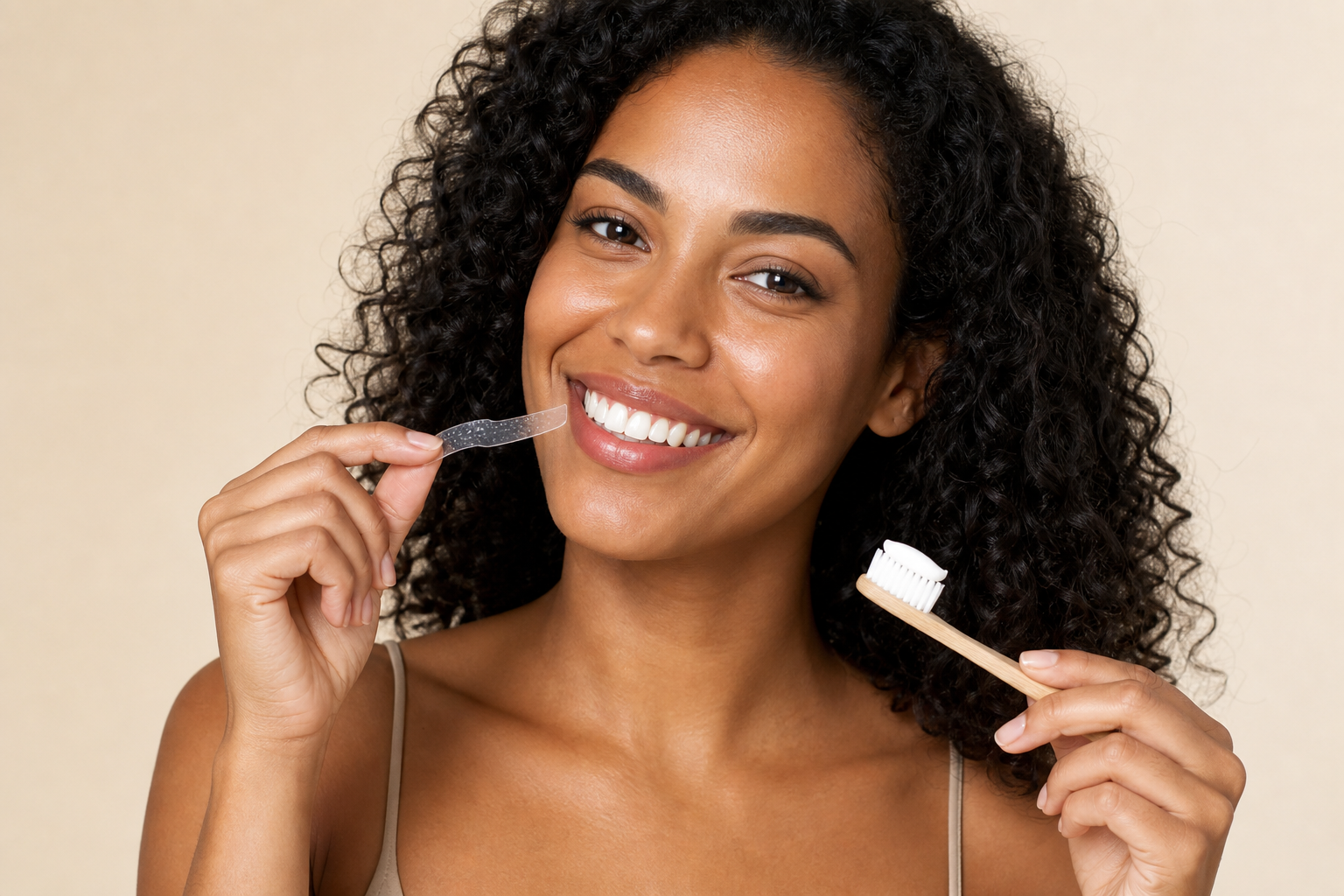
Teeth whitening strips and whitening toothpaste usually do different cosmetic jobs. Most whitening toothpastes polish away stains on the tooth surface. Most teeth whitening strips use peroxide to bleach natural teeth, so they are more likely to change tooth color beyond what surface cleaning can accomplish.
This is a teeth care comparison, not a recipe for aggressive teeth bleaching or improvised teeth whitening DIY. Both formats should be used exactly as directed, and neither should be stacked with another treatment in an attempt to speed up results.
That does not make strips the automatic winner. Your best fit depends on the type of discoloration, the change you want, your sensitivity, visible dental work, budget, and willingness to follow a timed treatment course.
Quick answer: Choose whitening toothpaste for daily cleaning and gradual surface-stain management. Consider peroxide strips if you want a broader bleaching effect on eligible natural teeth and can follow the product directions closely.
Whitening strips vs toothpaste at a glance
| Comparison point | Whitening toothpaste | Teeth whitening strips |
|---|---|---|
| Primary job | Usually removes external surface stains | Usually bleaches natural teeth with peroxide |
| Best fit | Mild staining from coffee, tea, red wine, tobacco, or similar sources | A cosmetic color change beyond surface-stain removal |
| Routine | Used during regular brushing | Applied separately for a label-defined time and course |
| Expected effect | A cleaner, brighter-looking surface, limited by natural tooth color | Potentially more noticeable bleaching, with no guaranteed shade change |
| Comfort | Not automatically irritation-free; formulas vary | May cause temporary sensitivity or gum irritation |
| Cost pattern | Can replace a toothpaste you already buy, although specialty formulas may cost more | Adds the cost of a separate treatment course |
| Restorations | Cannot recolor crowns, veneers, fillings, implants, or bonding | Bleaches natural teeth, not restorations, which may create a mismatch |
Whitening changes appearance, not dental health. White-looking teeth are not necessarily cleaner or healthier, and neither product treats cavities, gum disease, cracks, or unexplained discoloration.
What whitening toothpaste can realistically do
Whitening toothpaste is generally designed to remove extrinsic stains, meaning discoloration collected on the outside of teeth. According to the American Dental Association’s whitening overview, these formulas commonly rely on polishing or abrasive ingredients, although some also contain low levels of peroxide.
That makes toothpaste a practical option if your goal is to reduce visible surface staining or maintain a brighter-looking finish within your existing routine. Research reviews have found that whitening toothpastes can reduce external staining better than regular toothpastes, but formulas and study methods vary.
Toothpaste cannot necessarily change the underlying color of your teeth. If the warmer or darker tone is within the tooth rather than sitting on its surface, additional polishing may make little visible difference. Brushing harder or more often than directed is not a safe shortcut.
Also check whether the toothpaste contains fluoride. “Whitening” describes a cosmetic claim, not automatic cavity protection. The ADA’s home oral-care guidance recommends brushing twice daily for two minutes with fluoride toothpaste.
What peroxide teeth whitening strips can do
Most teeth whitening strips hold a peroxide-based gel against the teeth for a defined contact period. Hydrogen peroxide and carbamide peroxide are bleaching agents that can change the color of natural teeth rather than only removing surface deposits.
A systematic review of whitening dentifrices found that strips produced greater whitening effects than whitening toothpastes in the limited direct evidence available. The comparison involved only a small number of studies and participants, so it does not prove that every strip will outperform every toothpaste for every person.
Strips also require more commitment. Placement, frequency, contact time, and course length vary by product. Follow your specific label rather than copying someone else’s schedule. Do not wear strips longer, use them more frequently, sleep in them unless directed, or stack multiple bleaching products in an attempt to speed up the result.
Temporary tooth sensitivity and gum irritation are possible. Discomfort is not proof that a strip is working, and a lack of discomfort does not guarantee that it is appropriate for your mouth.
Choose according to the discoloration, not the package wording
Start by deciding whether you are trying to manage surface stains or bleach natural tooth color.
Whitening toothpaste may be enough when you have mild staining associated with drinks, foods, or tobacco and want an easy daily option. Strips may better match an eligible adult who wants more than stain removal and accepts the added time, cost, and possibility of sensitivity.
Do not assume all discoloration is cosmetic. A single darkening tooth, pain, a crack, untreated decay, active gum problems, or a color change after an injury needs dental assessment rather than stronger whitening.
The same caution applies if you already have persistent sensitivity. A licensed dentist can help determine whether whitening is suitable and whether the discoloration is likely to respond.
Consider restorations before bleaching
Crowns, veneers, implants, fillings, and bonding do not bleach like natural teeth. As MouthHealthy explains, whitening may leave dental restorations unchanged while nearby natural teeth become lighter.
That difference can make a restoration more noticeable, especially near the front of your smile. Toothpaste may remove some external staining from a surface, but it cannot change the restoration’s original color.
Speak with a dentist before whitening if you have extensive visible dental work or planned treatment where color matching matters. This is especially useful before committing to a complete strip course.
Compare the real routine and cost
Whitening toothpaste fits into brushing you already need to do, making it the lower-effort choice. A specialty formula may cost more than a basic fluoride toothpaste, but it does not necessarily add another step.
Strips require separate applications and careful timing. Instead of comparing package prices alone, look at:
- The active ingredient or stated stain-removal method
- Number of applications and total course length
- Contact time and frequency
- Warnings, age restrictions, and sensitivity directions
- Whether the toothpaste contains fluoride
- The exact claim associated with an ADA Seal, if present
- Total course cost rather than cost per box
The ADA Seal is voluntary. Its presence means a product was evaluated for the specific claim shown with the Seal, but its absence alone does not prove a product is unsafe or ineffective.
Make the safer practical choice
Before choosing either format, check for pain, damaged teeth, gum problems, persistent sensitivity, unexplained discoloration, and visible restorations. Ask a licensed dentist about pregnancy-related questions or any uncertainty about whether bleaching is appropriate.
If a product causes burning, severe pain, significant gum irritation, or sensitivity that persists after you stop, follow the label and seek professional advice. Otherwise, choose based on the job you actually want done: toothpaste for surface-stain management, or properly used peroxide strips for a potential bleaching effect on natural teeth.
