
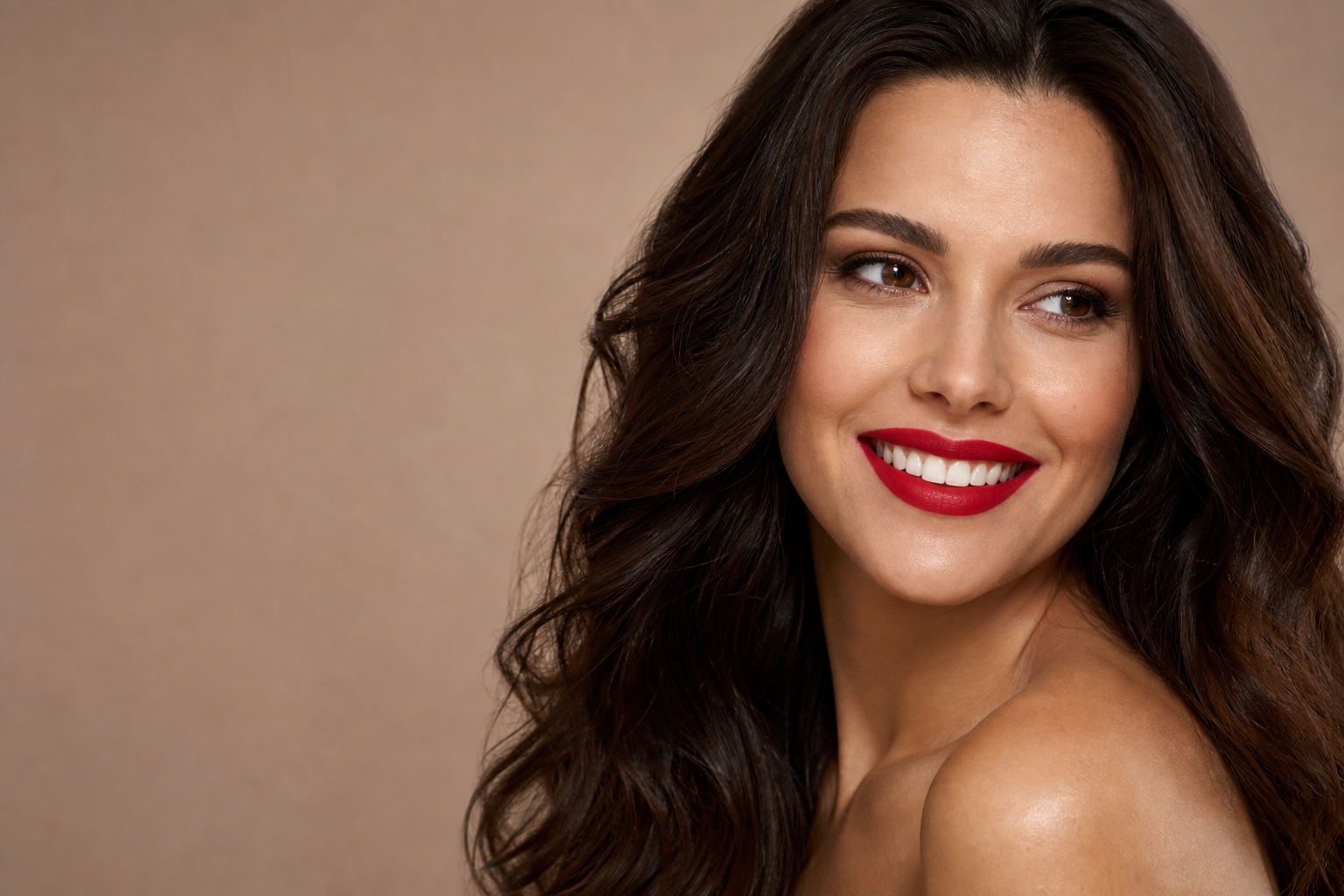
Red lipstick can make teeth look whiter by changing the color and contrast surrounding your smile. It does not remove stains or change the actual color of your teeth. Although cooler reds are often recommended for this effect, no undertone works universally. Your natural tooth and lip color, the lipstick’s finish, and even the room lighting can change what you see.
The final red lips look and overall red lips aesthetic depend on more than undertone. A matte or glossy red lips finish changes reflected light, while examples of red lipstick on brown skin also show why the same shade cannot be judged independently of complexion, natural lip color, and lighting.
Quick answer: Red lipstick may create the appearance of brighter teeth through visual contrast, but the most reliable choice is the red that works beside your smile in your real-life lighting.
Why Red Lipstick Can Make Teeth Look Whiter
Color is never viewed in complete isolation. The colors surrounding an object can influence how light, dark, warm, or cool it appears. With lipstick, the lips become a strong visual background around the teeth.
A small study on lipstick and perceived tooth color photographed four women without lipstick and with several lip colors. Observers generally rated teeth as looking whiter with bright red, dark red, and violet lipstick than with the beige shade. Bright red received the highest average rating.
That supports the basic contrast effect, but it does not prove that every bright red will work for every smile. The study included only four photographed smiles, and its broad color categories do not correspond neatly to every shade labeled “blue-red,” “brick,” or “classic red” at a beauty counter.
Depth can matter too. A saturated or deep lipstick may create more visible separation between the lips and teeth than a pale, beige, or sheer shade. Stronger contrast is not automatically better, however. It may also make uneven tooth color, lipstick transfer, or a restoration mismatch more noticeable.
Is a Blue-Based Red Always the Best Choice?
A cooler red, berry-red, or violet-red may make teeth appear brighter on some people. Still, “choose a blue-based red” is better treated as a starting point than a rule.
Commercial undertone descriptions are not standardized. One brand’s cool red may resemble another brand’s neutral berry. Lipstick also changes once it is applied because your natural lip pigment shows through, especially with sheer formulas.
Several other details influence the result:
- Natural tooth color: Teeth vary in lightness, translucency, and warm, gray, or reddish tones.
- Lipstick finish: Sheer, satin, cream, matte, stain, and gloss formulas reflect light differently.
- Opacity: A sheer red allows more natural lip color to influence the finished shade.
- Complexion: Skin and surrounding makeup affect how both lipstick and teeth are perceived.
- Personal style: A subtle brightness effect has little value if you dislike wearing the color.
Warm tomato, coral, brown-red, and brick shades do not automatically make teeth look yellow. Likewise, a cool red is not guaranteed to create your preferred effect. These are options to compare, not categories to avoid.
Lighting Can Change the Red Lipstick and White Teeth Effect
The same lipstick and smile can look different near a window, under warm bathroom bulbs, in cool LED lighting, or with a camera flash. Research on natural teeth has found that different white LED illuminants can produce perceptible changes in apparent tooth color.
Phone cameras add more variables. Exposure, white balance, distance, flash, portrait processing, filters, and display settings can all shift the appearance of lipstick and teeth. Technical research on tooth-shade photography similarly shows why consistent lighting and camera conditions matter when comparing images.
An edited creator photo or online product swatch therefore cannot tell you exactly how a lipstick will interact with your smile. Check shades in the places where you expect to wear them, especially if you are choosing a red for an event or photographs.
How to Compare Red Lipsticks on Your Own Smile
You do not need to buy a large lipstick collection for this test. Start with products you own, samples, or accessible testers used according to store hygiene practices.
- Choose two or three different reds. Try a cooler berry-red, a balanced red, and a warmer tomato or brick red if those options are available.
- Apply each shade fully to your lips. A hand swatch cannot show how the lipstick interacts with your lip pigment, face, and teeth.
- Check indirect daylight first. Then look at the shade under your usual indoor or event lighting.
- Keep comparison photos consistent. Use the same camera, distance, angle, expression, and light. Turn off beauty filters.
- Judge the whole look. Consider perceived tooth brightness, color preference, even application, transfer, finish, and comfort.
Stop using a lipstick that burns, stings, causes swelling, or aggravates cracked lips. The American Academy of Dermatology advises stopping lip products that irritate chapped lips. Persistent cracking, bleeding, sores, swelling, or recurrent irritation deserves guidance from an appropriate clinician.
Lipstick Contrast Is Not Teeth Whitening
Ordinary lipstick cannot bleach enamel, remove surface stains, or change restorations. According to the American Dental Association, whitening toothpastes primarily address external surface stains, while peroxide bleaching can change the color of natural teeth. Crowns, veneers, implants, fillings, and bonding do not whiten like natural teeth.
Tooth color is not a measure of cleanliness or health. If one tooth has newly darkened, or you have pain, swelling, damage, persistent sensitivity, or concerns about a restoration mismatch, consult a licensed dentist rather than trying to disguise the change with lipstick.
For your next shade check, apply a few different reds and view each one in consistent daylight and your intended indoor lighting. Choose the color you enjoy as a complete look, whether or not it produces the strongest contrast.
