
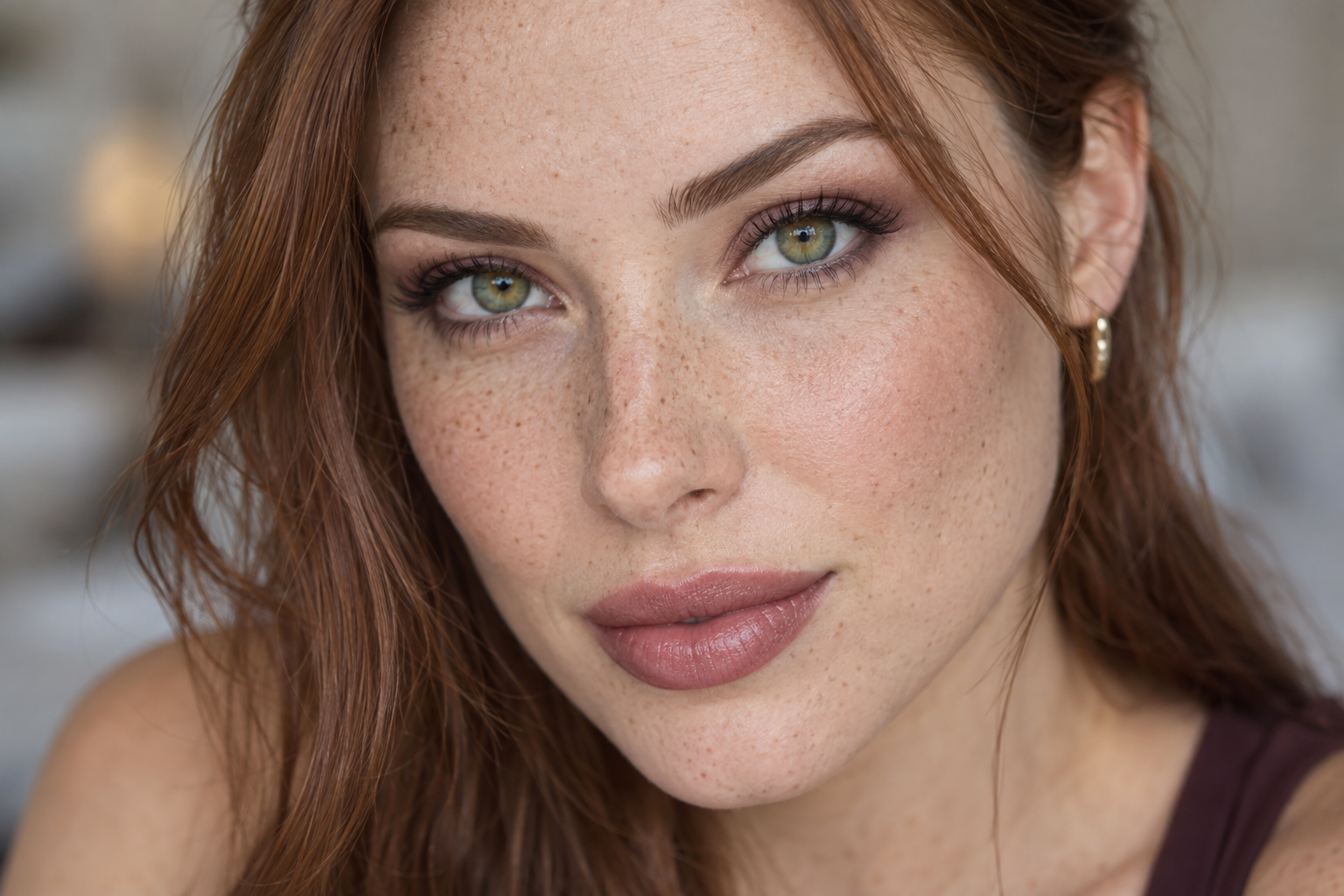
Purple shadow gets recommended for green eyes so often that it can feel like homework. But if a full purple lid feels louder than you wanted, the answer isn’t necessarily a different palette. It may be a smaller patch of color.
Makeup for green eyes can be softly neutral, gently contrasting, or beautifully green-on-green. Start with brown, plum, or olive, concentrate definition near the upper lashes, and check what’s visible with your eyes open. You’re choosing a frame for your eyes, not trying to change their color.
Quick answer: Try brown or taupe for subtle definition, muted plum for a contrasting accent, or olive for a coordinated look. Keep the deepest shade close to the upper lashes or outer lid, then soften the edge before adding more.
Choose your makeup for green eyes by the effect you want
Eye color gives you ideas, not instructions. The depth of the shade against your skin, its finish, and how much you apply all help determine whether the result feels quiet or dramatic.
Brown and taupe for easy, everyday definition
Brown eyeliner and neutral shadow are useful when you want your eyes framed without making the makeup itself the main event. Try caramel or warm brown if you enjoy golden tones; explore taupe or cooler brown if you prefer a less warm finish.
Choose depth relative to your skin. A pale beige isn’t everyone’s neutral, and a shade that barely shows in the pan may look chalky rather than subtle once applied. For gentle definition, look for a shade slightly deeper than your lid; for a clearer outline, try espresso or deep brown.
Plum and rose-brown for a little contrast
Muted plum, aubergine, and rose-brown offer color without requiring a bright purple lid. Start with one as eyeliner or a small outer-lid accent, leaving the rest of the lid neutral.
If a rosy shade gives a pinker effect than you enjoy, try a browner plum or add a slim dark-brown line at the lashes. You don’t need to keep building a color just because it’s supposedly “the one” for green eyes.
Olive and green for a coordinated look
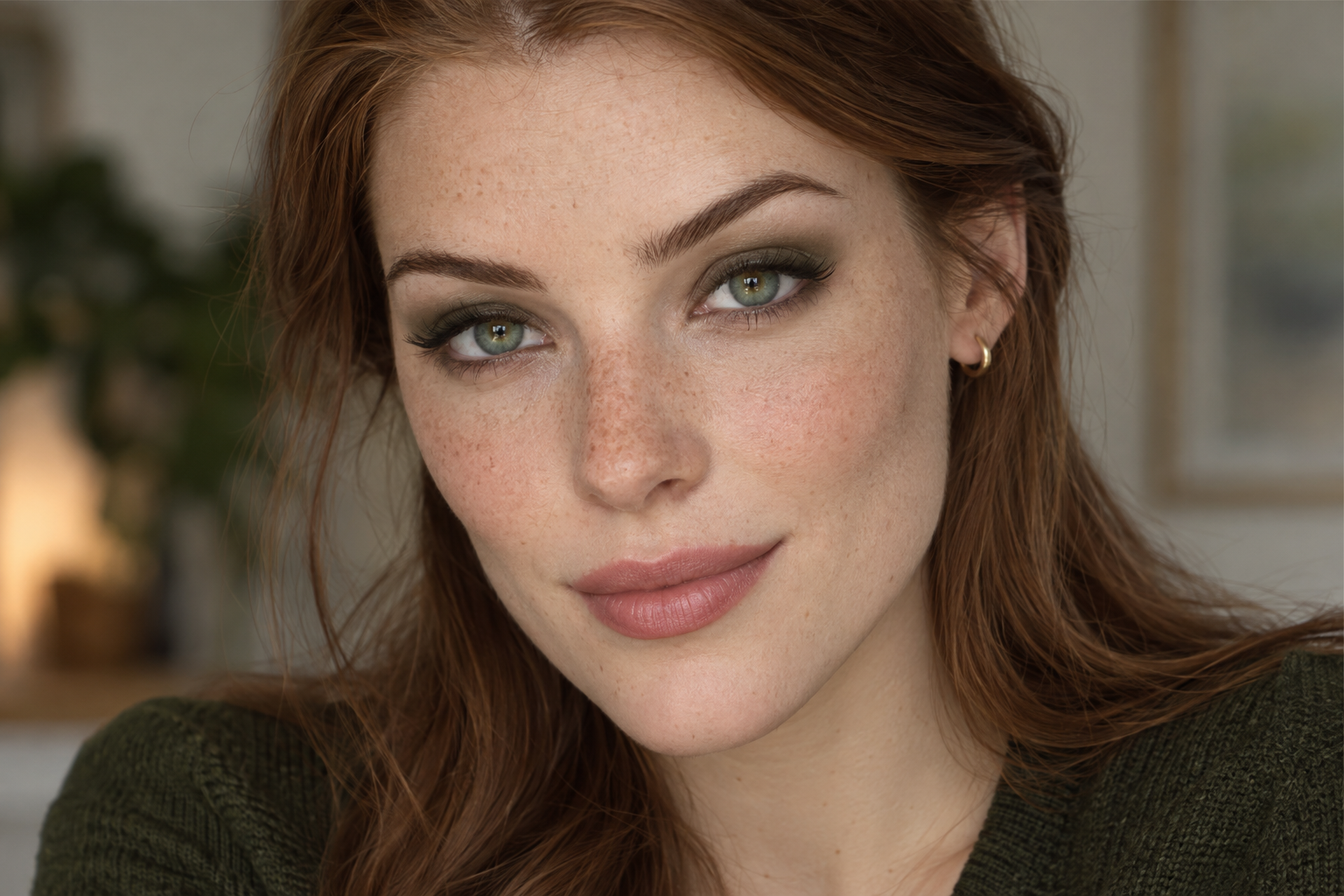
Green shadow isn’t off-limits. Olive, moss, and deeper forest shades can create a coordinated look, especially alongside brown definition.
Choose a green noticeably lighter or darker than your iris if you want some separation between the makeup and your eyes. A muted olive offers a gentler starting point than a bright emerald, but either can work if that’s the look you want.
Build a look that still works when your eyes are open
You only need a softly defining lid shade and one deeper accent for this routine. Use what you already own, provided it’s intended for the eye area.
- Map the placement before applying color. Look straight into the mirror with your brows relaxed. Notice how much lid shows and where the outer corner sits. Raising your eyebrows while applying can give you a lovely closed-eye look that disappears the moment your face relaxes.
- Lay down a light wash. Place your neutral shade across the mobile lid, the part that moves when you blink. With powder, pick up a little product, tap off excess, and blend the boundary with a lightly loaded brush. With cream, start in a small area and blend according to its directions; some formulas set before you’ve finished working across both eyes.
- Add definition along the upper lashes. Begin around the middle of the upper lash line and work outward in short strokes. Keep the accent narrow enough that you can still see lid above it. A blendable pencil can be softened with a small brush, if its directions allow; liquid liner is better treated as a deliberate line rather than smudged like pencil.
- Blend the edge, not the entire accent. Use a small brush to soften just the upper boundary of the liner or outer-lid shade. Sweeping repeatedly across all the pigment can spread a neat accent into a much larger smoky area. Keep most of the depth where you first placed it.
- Check, then finish. Open both eyes and relax your brows again. Decide whether you want more visible color, a deeper lash line, or nothing extra. Add mascara if you like. A wing and lower-lash shadow are optional, not unfinished business.
Use shadow and liner intended for the eye area, especially if you bring color close to the lower lashes.
If your shadow disappears, adjust its position first
Adding more pigment to the same hidden spot usually gives you a darker closed-eye look, not a more visible open-eye one.
With your eyes open, use a small brush to extend a little of the blended shade above the fold until a soft trace shows. Work in small increments and leave space beneath the brow. Then close your eye briefly to smooth the connection with the lid color.
This can be useful on hooded lids, but you don’t have to draw a new crease. If you’d rather keep shadow mostly hidden, let a thin lash-line accent carry the look instead.
Add shine or drama without expanding everything
For a reflective touch, tap a small amount of eye-safe shimmer onto the center of the lid. Keeping it localized gives you a light-catching detail without turning the whole eye metallic. Matte-only makeup is equally valid.
For more intensity, deepen the outer upper lash line before widening the shadow. Black liner is an option too: a narrow black line can look more restrained than a broad brown one. Width matters alongside color.
If you want lower-lash definition, start with a little shadow beneath the outer lashes rather than immediately tracing the entire eye. Check both eyes together before extending it inward.
Let the rest of your makeup support your choice
If you want the eyes to lead, choose blush and lip color that feel less visually assertive alongside them. That doesn’t have to mean pale lipstick: a softly applied berry, brown, or rose can feel quieter than a very light, opaque shade against your skin.
Look at the finished makeup in ordinary daylight as well as your bathroom mirror. If the color feels stronger than intended, soften its edge rather than automatically covering it with another shade.
For your next attempt, keep the experiment small: one familiar neutral, one accent along the outer upper lashes, and one relaxed, open-eye check. Change the placement before you buy another palette.
