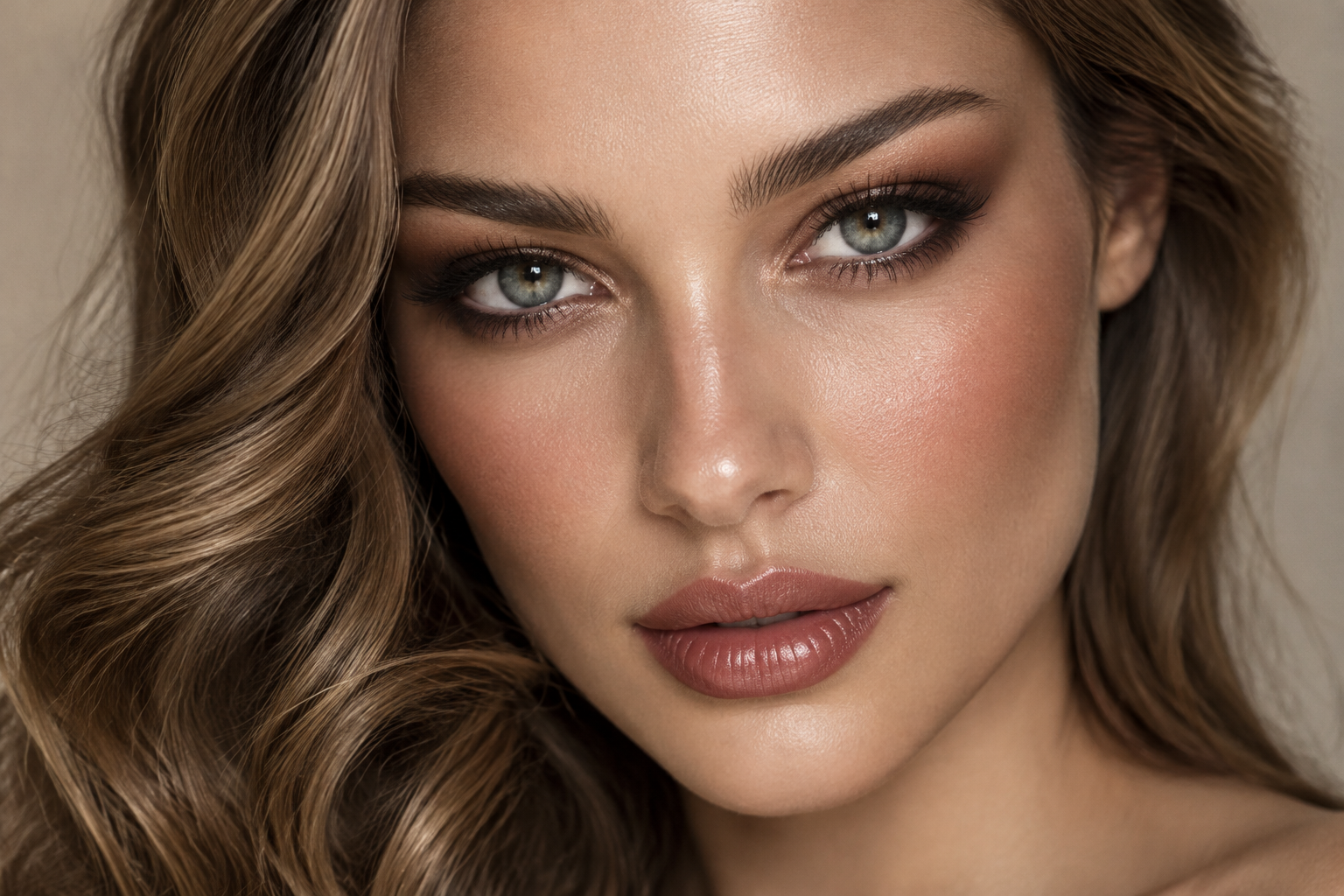
Your brown eyeshadow looks lovely, but once bronzer and nude lipstick join in, the colors suddenly stop getting along. The trick to latte makeup is choosing related browns with different jobs: soft warmth on the cheeks, more definition around the eyes, and a lip color that belongs with both.
You don’t need caramel on every feature or pale beige lips. A coordinated warm-brown look can be sheer or smoky, matte or glossy, with shades adjusted to your skin depth, undertone, and natural lip color.
Quick answer: Choose a brown color family, then vary the depth and finish. Keep cheek color diffused, concentrate deeper brown near the lashes, and blend brown-toned lip liner into your lip color rather than leaving a separate outline.
Choose Your Latte Makeup Shades Before You Start
Think of your palette as a small group of colors that get along, not identical swatches. Gather a main lid shade, a deeper eye shade, a cheek color, and a lip color. Products you already own may be enough.
These are starting points, not rules:
- Fair or light skin: Try a sheer beige-brown or rosy-brown cheek, light-to-medium brown eyeshadow, and a lip shade close to your natural lip color.
- Medium or tan skin: Explore caramel, bronze, cinnamon, or rosy-brown, with a deeper brown for eye definition.
- Deep skin: Consider chestnut, copper-brown, chocolate, or reddish-brown with enough pigment to show clearly. A pale beige lip isn’t required.
Undertone matters as much as depth. If golden browns look orange on you, compare a muted or rosy-neutral brown. If a shade turns gray or barely shows, try something richer or warmer.
Test lipstick on your lips when possible. A beige-brown that looks soft on your hand may look very different over naturally pink, brown, or two-toned lips. Aim for the contrast you enjoy, rather than chasing a particular “nude.”
Build the Look in Five Steps
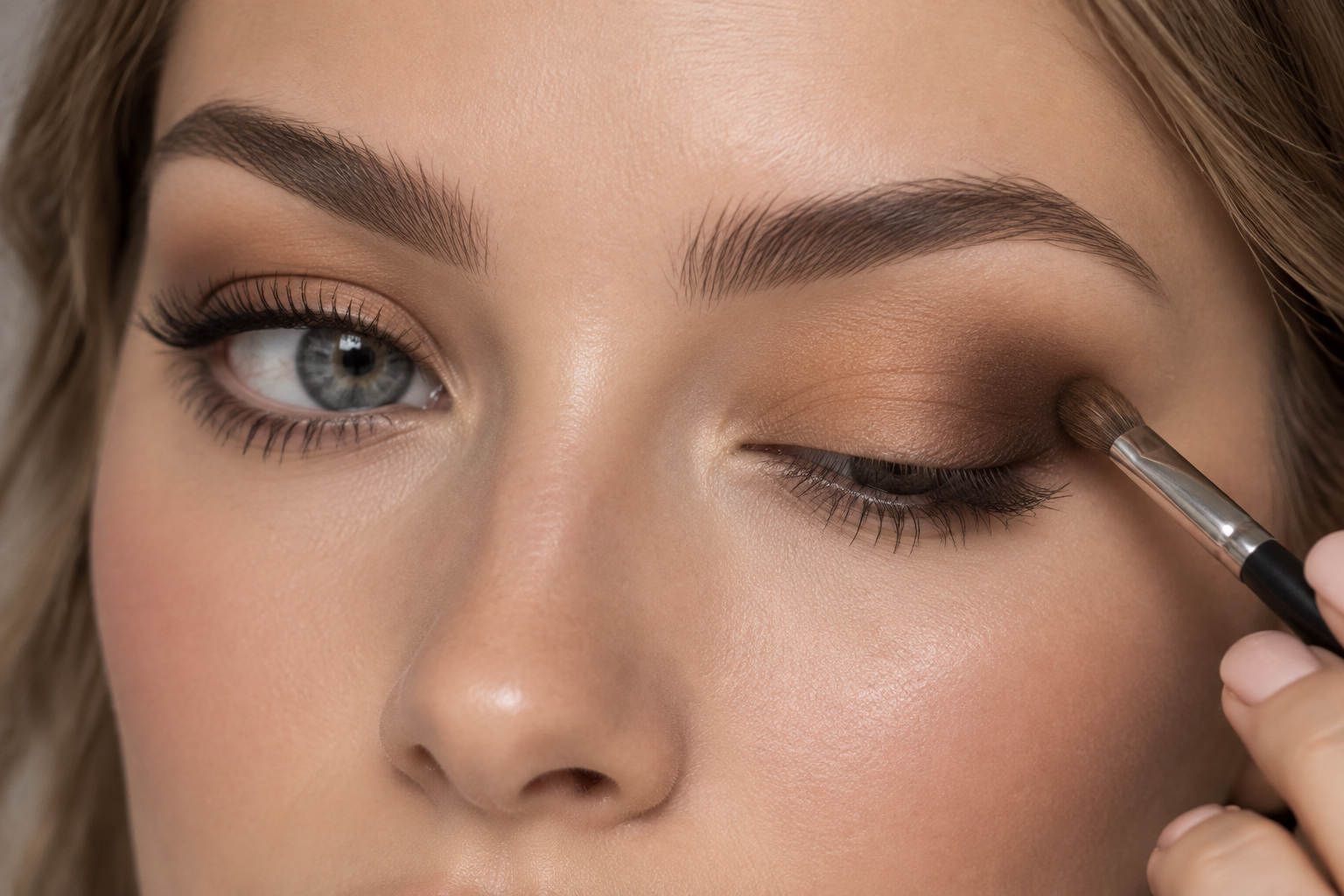
Follow this sequence, or do eyes before your base if your powder shadow tends to fall onto your cheeks.
Step 1: Keep your usual complexion match
Use your familiar foundation, skin tint, or concealer where you want coverage. The warmth comes from color placement, not darker foundation.
Satin, matte, and dewy skin all fit this look. If you plan to use powder bronzer, lightly set areas where your base still feels tacky so the first brushful doesn’t grab in one spot. Cream cheek color generally blends more easily before a powder layer.
Step 2: Give the eyes a soft brown background
Apply a small amount of your main brown across the mobile lid, then soften the upper edge. With powder, build gradually using a small brush. With a cream that sets, work one eye at a time and blend according to its directions before it becomes difficult to move.
Look straight ahead with your eyes open. If the color disappears into a fold, extend a little of the softer shade just above it where you can see it. You don’t have to draw a high, dark crease to make the makeup visible.
Use products intended for the eye area, rather than automatically borrowing bronzer or lip liner. The FDA advises stopping eye cosmetics that cause irritation, seeking medical advice if irritation persists, and avoiding application to an inflamed or infected eye area.
Step 3: Add definition without enlarging the dark area
Press deeper brown close to the upper lashes and, if you like, onto the outer third of the lid. Use a clean small brush to soften its boundary, leaving most of the darkest pigment where you placed it.
This is the easily missed detail: blending doesn’t mean sweeping that deep shade across the whole eye. Keeping it concentrated gives the lighter brown room to show.
A little shadow beneath the outer lower lashes is optional. Skip it for a softer look, or keep it close to the lash line rather than creating a wide band. Finish with brown or black mascara, whichever gives you the definition you prefer.
Step 4: Place cheek warmth selectively
Start on the outer cheekbone and blend toward the temple. Add a light touch around the forehead perimeter if you want, but leave the center of the face less saturated.
For powder, tap excess off the brush and build with light passes. For cream, place a small amount first, then tap outward with a brush, sponge, or fingertips instead of rubbing it across your base.
You can absolutely include blush. A restrained rosy-brown, peach-brown, or terracotta can bring a little color back when bronzer alone feels too beige. Use less bronzer in the same area rather than piling both on heavily.
Step 5: Connect the lips with a softened brown edge
Trace your natural lip border with a brown-toned liner, then feather it slightly inward using short strokes or a lip brush. Use light pressure with a creamy pencil; blend a quick-setting formula in small sections.
Add lipstick, tinted balm, or gloss over that transition. The center can be lighter than the edge, but choose how much contrast you want. For a soft version, keep the liner and lip color fairly close in depth.
Matte lips work just as well as glossy ones. If you’ve added shimmer to the lids, a satin lip offers a quieter finish; with mostly matte makeup, gloss can be your single reflective accent.
Check the Balance Before Adding More
Step into neutral daylight and look at your whole face, not just each feature up close. Try one adjustment at a time:
- Too orange: Remove a little cheek product and compare a less golden brown. Adding more brown won’t necessarily reduce the orange.
- Too uniformly dark: Keep the lash-line definition, but soften the cheeks or choose a sheerer lip finish.
- Too flat: Vary depth or texture. A deeper lash line or a small satin accent may be enough.
- Colors feel disconnected: Check undertones. Strong copper cheeks beside gray-brown eyes may need a more neutral cheek shade, not another layer of eyeshadow.
The useful shortcut is one softly blended cheek shade, one deeper eye accent, and one lip transition. Start there, then decide whether you actually want more. Latte makeup doesn’t need a full face of equally brown pigment; it needs the colors to feel like they belong together.