
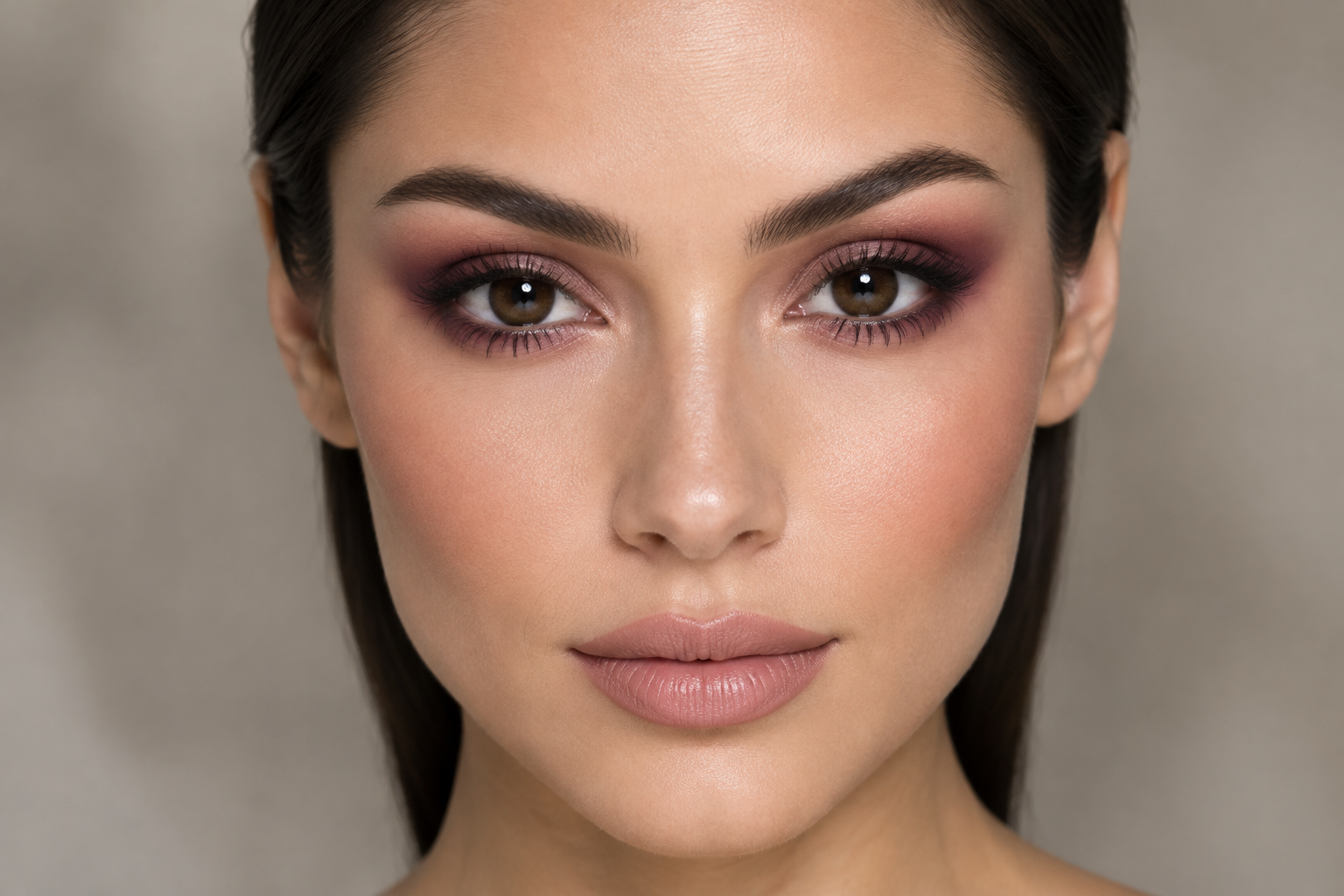
It’s easy to reach for bronze shimmer again when the colorful shades in your palette feel like more of a commitment. For makeup for brown eyes that takes a different direction, try plum with rose-taupe at the outer corner, navy with neutral taupe along the upper lashes, or olive with espresso across the lid.
The trick is giving the color one clear home, rather than blending it everywhere. These aren’t rules about what brown eyes can wear. They’re three approachable ways to make a little color feel intentional.
Quick answer: Choose plum and rose-taupe for a soft outer-corner accent, navy and taupe for a narrow colored liner, or olive and espresso for a muted colored lid. Keep the neutral supportive and the accent visible.
Plum + Rose-Taupe: Keep the Color at the Outer Corner
This pairing is a lovely starting point if you want something softer than a full purple lid. Rose-taupe provides a quiet background, while plum adds depth in one small area.
Choose a rose-taupe that looks softly rosy-brown against your skin, not necessarily the palest shade in the palette. A deeper rose-brown can do the same job if a light taupe looks chalky.
- Lay down the base. Sweep a sheer layer of rose-taupe over the mobile lid, the part that moves when you blink. Use a small amount so it doesn’t become an opaque pastel background.
- Press on the plum. With a small brush, place it on the outer third of the lid, starting close to the upper lashes. Build upward a little, keeping the center of the lid mostly rose-taupe.
- Soften the boundary. Use a clean small brush to blur the plum’s upper and inner edges. Leave the color nearest the lashes more concentrated.
That last step matters: blending the whole plum patch can turn two distinct shades into one indistinct wash. You want a soft border, not a disappearing act.
For powder, add another light layer only where you want more depth. For a cream, blend according to its directions while it’s still workable; setting formulas may resist adjustment later.
Want an even smaller experiment? Keep the rose-taupe lid and use plum eyeliner just along the outer upper lashes. You still get the pairing without committing to a larger patch of color.
Navy + Neutral Taupe: Let the Lash Line Carry the Color
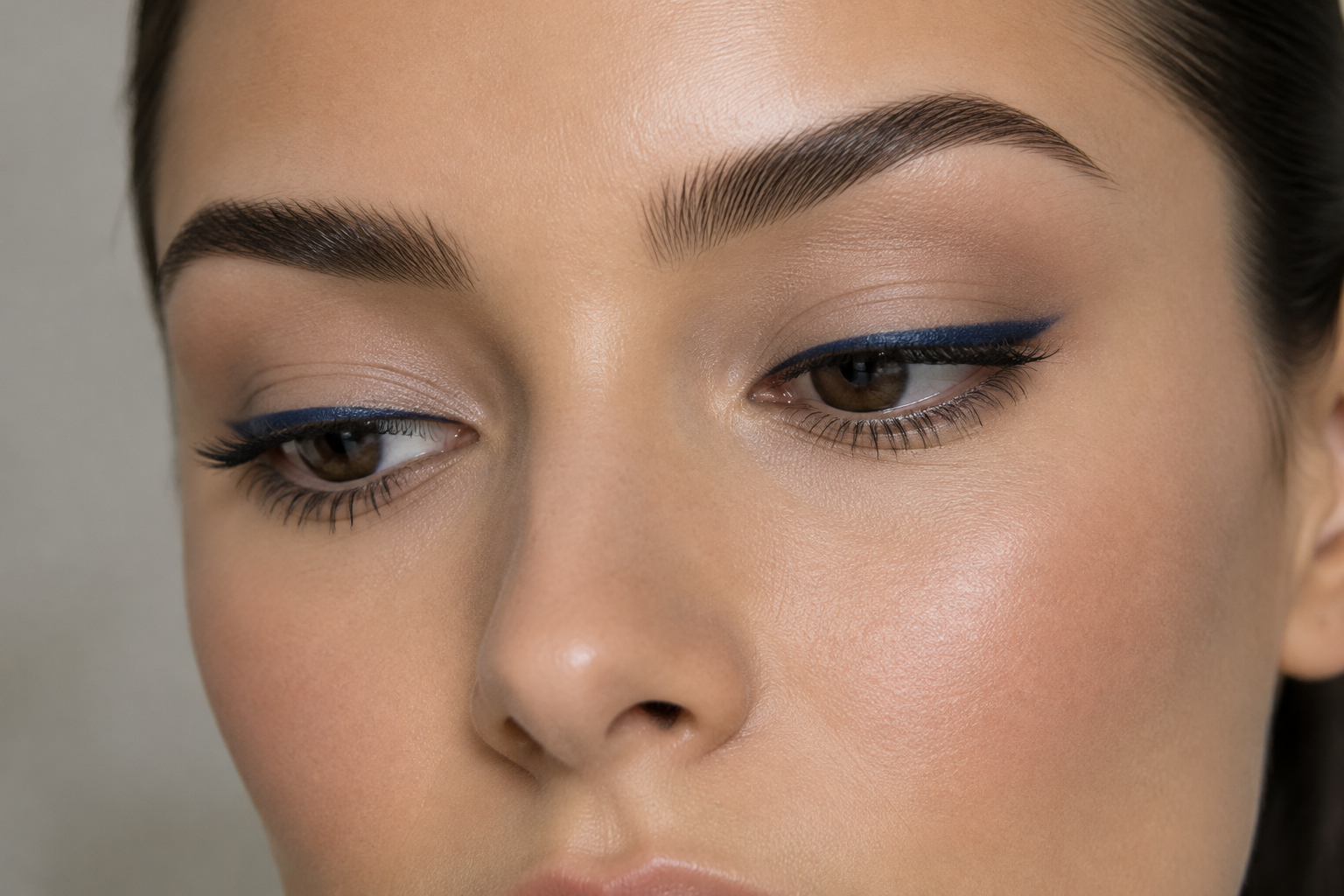
Navy liner gives you a colorful detail without asking you to blend a colorful eyeshadow look. From farther away, a deep navy may read almost like a dark neutral; closer up, the blue becomes more noticeable.
The taupe here should be understated. Choose a muted brown-gray that gives your lid a little definition without competing with the liner.
- Apply a light taupe wash. Sweep it over the lid and diffuse the upper edge. Skip a heavy smoky outer corner so the navy remains the focal point.
- Connect short strokes. Apply navy on the skin immediately above the upper lashes, working in small sections instead of attempting one long sweep. Keep the line narrow, especially toward the inner corner.
- Choose your edge. Leave it crisp, or soften only the top boundary with a small brush if your formula allows smudging. You can make the outer third slightly thicker without adding a wing.
A blendable pencil or gel suits a softer result, but follow its application instructions rather than assuming every formula has the same blending window. A liquid liner is better treated as a crisp line unless its directions say otherwise. Trying to blur a drying liquid often creates gaps rather than softness.
Use eye-area products and follow placement warnings; there’s no need to line the waterline. The FDA advises stopping an eye cosmetic that causes irritation and seeking medical advice if irritation persists. Avoid applying makeup over an active eye infection or inflamed surrounding skin.
Olive + Espresso: Give the Lid a Muted Green Wash
If you’re ready for color beyond a small accent, olive is an earthy way in. Look for a muted green with a brown or gray influence, rather than assuming you need a bright green to make the look worthwhile.
Espresso provides definition, but its job is to frame the olive, not cover it.
- Pat olive onto the lid. Use the flat side of a shadow brush to place powder across the mobile lid. For a cream, apply a small amount with the tool recommended by its directions.
- Diffuse the upper edge. Gently soften where the olive meets bare skin. Keep most of the pigment on the lid rather than sweeping it high toward the brow.
- Add espresso close to the lashes. Use a small angled brush or an eye pencil for a slim upper-lash line. Add a little espresso at the outer corner if you’d like more depth, leaving the center visibly olive.
Check the proportions before adding more brown. If the olive is only visible as a tiny spot in the middle, the espresso has taken over. Keep the darker shade narrower next time.
Matte olive gives a flatter, more understated finish. Satin or fine shimmer catches light and makes the lid color more noticeable. Neither finish has an age requirement; choose the texture you enjoy.
For a quieter version, begin with a sheer olive layer and skip the extra espresso at the outer corner. A narrow dark lash line is enough to finish the look, with mascara if you want it.
Adjust the Placement Before You Add More Product
With any pairing, look straight into the mirror with your eyes open and brows relaxed. A look that appears balanced on a closed lid may be mostly hidden in your normal expression.
If the plum or olive disappears into a fold, extend its upper boundary slightly, then check again. You don’t need to carry it all the way toward the brow. For navy, keeping the line thin helps preserve whatever lid space is visible.
Also check your neutral in ordinary light:
- Too pale or ashy? Try a deeper rose-brown or mushroom taupe.
- Too strong beside the accent? Use less neutral rather than automatically adding more color.
- Accent looking muddy? Switch to a clean brush and blend only the boundary.
Skin depth, shade opacity, and your preferred contrast matter more here than a strict undertone label. A comparable shade you already own is a sensible place to start.
Pick One Color Zone for Your Next Look
Choose by placement: outer corner for plum, lash line for navy, lid for olive. That’s the useful distinction, not which shade is supposedly “best” for brown eyes.
Try one pairing with your existing makeup, check it with your eyes open, and adjust the edge before increasing the intensity. You don’t need a new palette or a full smoky eye to give your usual routine a different mood.
