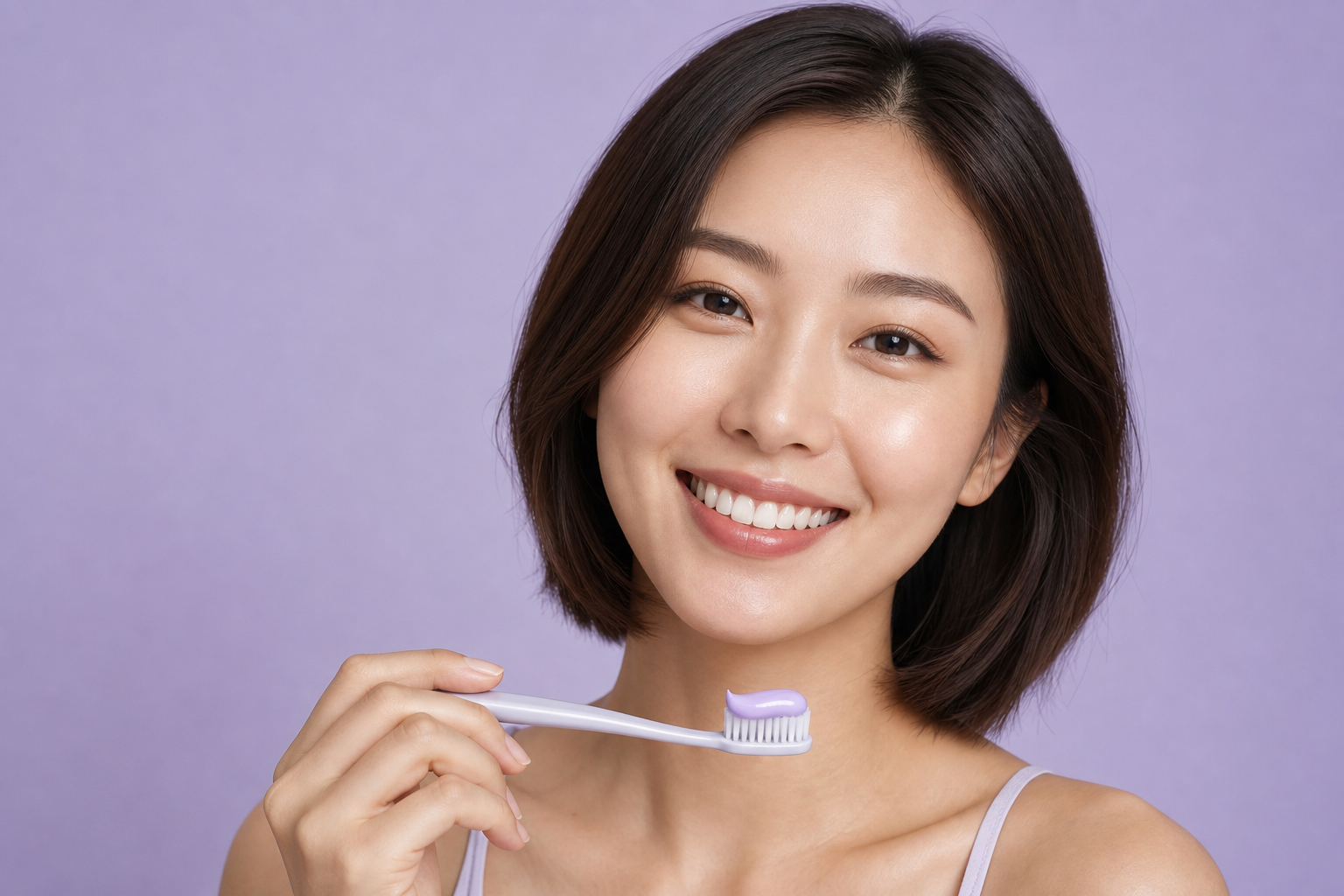
Purple toothpaste can make teeth look less yellow for a short time, but the purple colour does not bleach your teeth. It works mainly as optical colour correction. A thin tint on the tooth surface changes how yellow tones look to your eye and your camera.
That effect can be real and visible. It is a different job from removing stains or lightening the tooth's actual shade, and purple products are not all made the same way.
Quick answer: Purple pigment can temporarily reduce the look of yellow tones. Polishing ingredients in some formulas may remove surface stains over time. Only peroxide bleaching changes the colour inside natural teeth. Read the ingredient list, not the colour of the paste.
How purple colour correction works
Purple and yellow sit opposite each other on the colour wheel, so a violet or blue tint can make yellow read as more neutral. You may know the idea from colour-correcting makeup or purple shampoo.
On teeth, the tint doesn't erase anything. Pigments such as blue covarine can deposit on the tooth surface and shift perceived colour away from yellow, according to a review and meta-analysis in the International Journal of Dental Hygiene. The tooth underneath keeps its shade.
What the research actually shows
The evidence is interesting but limited.
- A randomised crossover study in the International Dental Journal found blue-covarine toothpastes increased measured whiteness and reduced yellowness immediately after one brushing compared with a standard silica toothpaste. It was manufacturer-funded, measured only the moment after brushing, and excluded people with restorations or visible stains.
- The meta-analysis found some improvement in measured colour and perceived whiteness. However, only five human studies qualified, methods varied, and some comparisons showed no meaningful advantage over regular toothpaste.
- In the comparisons it cited, blue-covarine toothpastes did not match conventional at-home or in-office bleaching.
That research also covers blue covarine specifically. Many products sold as purple toothpaste use a blend of blue and red dyes, so the findings don't automatically apply to every formula you see online.
Lighting, moisture, camera settings, and editing can also change how a quick demo looks. You may notice a difference, or you may not.
Colour correction vs stain removal vs bleaching
These three mechanisms often get grouped together as "whitening," but they do different things.
| Mechanism | What does it | What changes | How long it lasts |
|---|---|---|---|
| Optical colour correction | Purple or blue pigment | How yellow tones look on the surface | Temporary |
| Surface-stain removal | Abrasives or polishing agents, such as hydrated silica | External stains from things like coffee or tea | Gradual, depends on habits |
| Peroxide bleaching | Hydrogen or carbamide peroxide | Coloured compounds within natural teeth | Varies by person and product |
The American Dental Association explains that whitening toothpastes mainly use abrasives to remove surface stains and generally don't significantly change a tooth's underlying colour. Peroxide works differently: MouthHealthy notes that it breaks down coloured compounds so their colour becomes less concentrated.
So if a purple toothpaste seems to lift coffee stains over a few weeks, that comes from its polishing ingredients, not the purple dye. If a formula contains peroxide, the peroxide does the bleaching.
How to read a purple product label
"Purple toothpaste" in a video can mean very different products. Some are fluoride toothpastes containing silica and dyes. Others are peroxide-free colour-correcting serums designed for a temporary look.
- Check the category. Is it an anticavity toothpaste with brushing directions, or a separate colour corrector or serum?
- Look for fluoride. It indicates cavity protection. The ADA advises using a fluoride toothpaste for daily brushing.
- Look for polishing agents. Hydrated silica or similar ingredients may help with surface stains.
- Find the colourant. Blue covarine or blue and red dyes provide the optical effect.
- Check for peroxide. Hydrogen peroxide or carbamide peroxide means there is a bleaching component.
Then match the mechanism to your goal:
- A temporary tweak before photos or an event: a colour corrector may fit.
- Fewer everyday coffee or tea stains: a stain-removal toothpaste with supporting evidence makes more sense.
- A lighter underlying shade on natural teeth: look into peroxide options with realistic expectations.
An ADA Seal shows a submitted product met the ADA's criteria for its stated purpose. It's voluntary, so a missing seal doesn't automatically mean a product is unsafe or ineffective.
Restorations, sensitivity, and your daily routine
- Restorations: Crowns, veneers, fillings, implants, and bonding don't bleach like natural teeth. There isn't enough evidence that purple pigment evens them out either, so a mismatch may stay visible.
- Peroxide-free isn't risk-free: dyes, flavourings, and other ingredients can still irritate some mouths. If you notice burning, marked gum irritation, swelling, or persistent sensitivity, stop and follow the label or get professional advice.
- Keep your fluoride toothpaste: a cosmetic serum shouldn't replace it unless the label identifies it as an anticavity toothpaste. Keep brushing and cleaning between your teeth as usual.
- Use it as directed: don't brush more often, leave products on longer, sleep in them, or stack several whitening products to chase a stronger result.
And for the record, warm-toned teeth aren't dirty or unhealthy. Natural tooth shades vary, and whiter-looking teeth are a cosmetic preference, not a measure of oral health.
When to check with a dentist first
Talk to a licensed dentist before whitening if you have:
- Tooth pain, a cracked tooth, decay, or gum problems
- A single tooth that's dark or changing colour
- Persistent sensitivity or past reactions to whitening or toothpaste
- Several visible crowns, veneers, fillings, or bonding, or a planned restoration
- Pregnancy-related questions or uncertainty about what's causing a colour
A dental exam can help identify the cause of discolouration before you spend money on a product that can't reach it.
Your next step
Decide which result you actually want: a temporary colour tweak, fewer surface stains, or a lighter natural shade. Then turn the product over and read the ingredients before the purple colour makes the decision for you.